
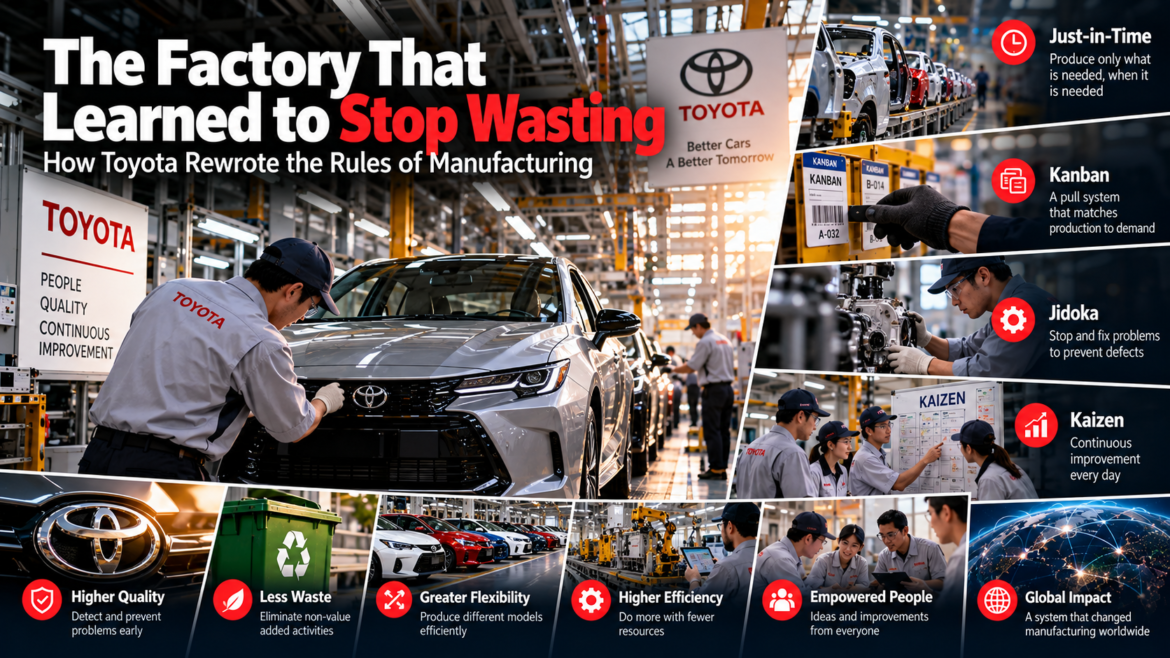
For most of the 20th century, the conventional wisdom of manufacturing was simple: make more, keep machines busy, build inventory, and push products through the factory as efficiently as possible.
Toyota challenged that logic.
Its engineers faced a very different reality: a relatively small Japanese automaker, limited capital, scarce materials, and a domestic market that could not support the enormous production volumes of Detroit’s automobile giants.
So Toyota had to answer a difficult question:
How do you manufacture high-quality cars efficiently when you cannot afford to manufacture enormous quantities of them?
The answer became the Toyota Production System (TPS).
It introduced ideas that would eventually influence manufacturing, healthcare, software development, supply chains, retail and management around the world.
Just-in-Time.
Kanban.
Jidoka.
Kaizen.
Pull systems.
Continuous improvement.
Waste elimination.
These terms are now part of the vocabulary of modern business.
But the interesting part of the story isn’t the terminology.
It is the problem that created the system.
Toyota didn’t set out to invent “lean manufacturing.”
It was trying to survive.
The problem began with scarcity
Toyota’s manufacturing philosophy can be traced back even before the company became an automobile manufacturer.
Sakichi Toyoda, founder of the Toyoda Group, developed automatic looms that could detect problems such as a broken thread and stop automatically.
The principle was simple:
Don’t allow a machine to continue producing defective output.
Toyota later developed this idea into what it calls jidoka, sometimes translated as “automation with a human touch.”
The philosophy was already different from simply maximizing machine utilization.
A machine running continuously isn’t necessarily productive if it is producing defective products.
That distinction would become fundamental to Toyota’s manufacturing philosophy.
Then came the automobile
Kiichiro Toyoda, Sakichi’s son, became interested in automobile manufacturing.
Toyota’s own history describes how Kiichiro, after seeing the automobile industry developing in the United States during the 1920s, decided to pursue domestic automobile production in Japan.
But Japan did not have the same industrial scale as the United States.
The problem was not simply building cars.
It was building them economically.
American manufacturers had developed enormous factories capable of producing large volumes.
Toyota couldn’t simply copy the same system.
The market was different.
The resources were different.
The economics were different.
So the production system had to be different.
Toyota’s uncomfortable constraint became an advantage
Toyota faced a manufacturing paradox.
It needed to become more productive.
But it couldn’t simply produce huge quantities of identical cars and hope customers would buy them.
It needed flexibility.
It needed to produce different models and configurations.
It needed to minimize inventory.
And it needed to avoid wasting scarce resources.
That led to a radically different question:
What if the factory produced only what was needed, exactly when it was needed?
That became the foundation of Just-in-Time.
Toyota describes Just-in-Time as producing only what is needed, when it is needed, and in the quantity needed.
It sounds obvious today.
At the time, it represented a fundamental departure from conventional manufacturing logic.
The supermarket idea
One of the most famous stories in the development of the Toyota Production System involves a supermarket.
After World War II, Toyota was trying to catch up with the productivity of American manufacturers.
According to Toyota’s own account, engineers drew inspiration from the way supermarkets replenish products.
A supermarket doesn’t continuously manufacture products because a shelf exists.
Customers take products.
The store replenishes what has been taken.
Toyota applied a similar principle to manufacturing.
Instead of the previous process deciding what the next process should receive, the downstream process would effectively pull what it needed from the preceding process.
This became the pull system.
And it changed the direction of information inside the factory.
From “push” to “pull”
Imagine a traditional production system.
Management forecasts demand.
The factory produces components.
Those components are pushed forward.
More components are produced.
More inventory accumulates.
Eventually, someone discovers that demand wasn’t what the forecast predicted.
Now the factory has a problem.
Toyota’s approach was different.
The next stage signals what it needs.
The previous stage replenishes it.
Demand therefore travels backward through the system.
Materials move forward.
Information moves backward.
That distinction is one of the most important ideas in modern operations management.
Kanban made the system visible
Toyota developed kanban as a way to coordinate the pull system.
Kanban signals tell an upstream process what has been consumed and therefore what needs to be replenished.
Toyota describes the system as one in which the downstream process retrieves what it has used from the preceding process, with kanban helping coordinate the movement.
The brilliance was its simplicity.
Instead of relying entirely on massive centralized planning, the production system could communicate through relatively simple signals.
Something had been consumed.
Therefore:
Replace it.
Inventory stopped looking like an asset
Traditional manufacturing often treated inventory as useful.
If you have thousands of components sitting in a warehouse, you can feel prepared.
Toyota looked at the same inventory differently.
Inventory can hide problems.
Too much inventory can conceal:
- Quality problems
- Supplier problems
- Production bottlenecks
- Forecasting mistakes
- Machine failures
- Process inefficiencies
A large inventory buffer makes a system feel safe.
But it can also prevent managers from seeing what is actually going wrong.
Toyota’s philosophy was closer to:
Reduce the inventory and expose the problem.
That is a powerful management idea.
Waste became the enemy
Toyota’s production philosophy placed enormous emphasis on eliminating muda, commonly translated as waste.
Waste could include producing too much.
Moving materials unnecessarily.
Waiting.
Excess inventory.
Defects.
Unnecessary processing.
Unnecessary transportation.
The goal was not simply:
Work harder.
It was:
Remove work that shouldn’t exist.
That distinction became one of the defining ideas of lean management.
Toyota describes TPS as being rooted in the pursuit of the complete elimination of waste and in continuous improvement.
Then Toyota made a radical decision about defects
Here is where jidoka becomes important.
Imagine a factory where stopping the production line is considered a failure.
Workers are rewarded for keeping production moving.
A defect appears.
The easiest thing to do is keep going.
Fix it later.
Toyota reversed the logic.
If an abnormality occurs, the process should be able to stop.
Toyota’s production system allows equipment to stop automatically when abnormalities are detected, while workers can also stop the line using an andon or stop cord.
The reasoning is profound:
A defect is cheaper to solve at the moment it occurs than after it has moved through the entire production system.
Stopping the line can increase productivity
This sounds contradictory.
How can stopping production make production more efficient?
Because the alternative may be worse.
Suppose a faulty component enters a production line.
If nobody notices it, the defect may pass through several stages.
More labor is added.
More components are attached.
Eventually, the completed vehicle contains a problem.
Now fixing the defect is expensive.
But if the system stops immediately, the problem is identified near its source.
The factory loses some production time.
But it avoids creating a larger problem.
This is a crucial lesson:
Local inefficiency can sometimes prevent system-wide waste.
The worker became part of the quality system
This also changed the role of the factory worker.
In a conventional hierarchy, workers may simply execute instructions.
Toyota’s system gives workers a role in identifying problems and improving processes.
That makes the person closest to the work an important source of information.
This is one reason the Toyota Production System is often misunderstood as simply a cost-cutting system.
MIT Sloan has noted that lean management is frequently reduced to layoffs and cost cutting, even though its underlying philosophy is much more focused on how work is designed and improved across an organization.
The system is about productivity.
But productivity comes from improving the process, not merely demanding more from people.
Taiichi Ohno enters the story
One of the central figures in turning these ideas into a coherent production system was Taiichi Ohno.
Ohno worked his way through Toyota’s manufacturing organization and became one of the principal architects of what became the Toyota Production System.
Toyota describes Ohno as a key figure in establishing TPS and creating the basic framework for its Just-in-Time method.
His work focused heavily on identifying waste and improving flow.
The question was repeatedly:
What is preventing the system from working smoothly?
The factory became a laboratory
This is one of the most important differences between Toyota’s philosophy and conventional management.
The production system wasn’t treated as something that could be designed once and then left alone.
It evolved.
Workers identified problems.
Managers investigated them.
Processes changed.
The new process was tested.
More problems appeared.
The process changed again.
This created a continuous loop:
Observe → identify → solve → standardize → improve
That philosophy became closely associated with kaizen, or continuous improvement.
Kaizen changed the idea of innovation
When people hear “innovation,” they often imagine:
- A breakthrough invention
- A new technology
- A revolutionary product
- A dramatic scientific discovery
Toyota demonstrated another form of innovation.
Incremental innovation.
A worker discovers that a tool is awkward.
The process changes.
A material is moved closer.
A step is eliminated.
A defect is detected earlier.
A workstation is redesigned.
A supplier changes delivery timing.
Each improvement may look insignificant.
Together, thousands of improvements can transform an organization.
That is the power of kaizen.
Toyota didn’t eliminate planning
There is another misconception worth correcting.
Just-in-Time does not mean having no inventory.
Toyota’s own explanation makes this clear.
The system maintains the minimum necessary inventory at various points so that production can continue while replenishment occurs.
The objective is not:
Zero inventory at any cost.
It is:
The right inventory, in the right place, at the right time.
That distinction matters enormously.
The supplier became part of the factory
Toyota’s production system could not work if suppliers operated independently.
If Toyota wants a component at a specific time, the supplier has to coordinate with the production system.
That means the production system extends beyond the factory walls.
Toyota describes close coordination with parts suppliers as an essential part of Just-in-Time production.
The “factory” therefore becomes much larger.
It includes:
Toyota
→ suppliers
→ logistics providers
→ production plants
→ dealers
→ customers
The system is interconnected.
This was more than a factory trick
By the 1970s and 1980s, the performance of Japanese automakers attracted increasing attention in the United States.
Researchers began studying what was different.
The answer wasn’t simply better machinery.
It was a different way of organizing production.
The term lean production eventually became widely associated with the approach.
MIT Sloan describes Toyota’s production practices as pioneering the lean management and manufacturing approach that later spread globally.
The ideas began moving outside Toyota.
Then came NUMMI
One of the most interesting chapters in the story happened in California.
In 1984, Toyota and General Motors created New United Motor Manufacturing, Inc. (NUMMI) in Fremont, California.
The plant had previously been operated by GM.
Toyota brought its production approach into the joint venture.
The experiment became an important real-world demonstration that the system could operate outside Japan.
Toyota records that NUMMI operated for 25 years and produced nearly 8 million vehicles before closing in 2010.
The significance of NUMMI was larger than its production numbers.
It challenged the assumption that Toyota’s manufacturing system depended on Japanese culture alone.
The real innovation was organizational
A machine can be purchased.
A robot can be installed.
A software system can be licensed.
But a production philosophy is harder to copy.
Toyota’s competitive advantage came partly from the way people, processes, suppliers, machines and information interacted.
That makes TPS a useful lesson for today’s technology companies.
Buying the same tools as your competitor doesn’t necessarily give you the same capabilities.
Capabilities live in systems.
Lean escaped the factory
The most surprising part of the Toyota story is how far the ideas traveled.
Lean principles were studied and adapted in:
- Aerospace
- Healthcare
- Software
- Retail
- Supply chains
- Construction
- Government
- Financial services
MIT research documents efforts to apply Toyota-inspired lean principles to the U.S. defense aerospace industry, including aircraft, electronics, engines and space systems.
The ideas had escaped the automobile factory.
Software developers discovered the same problem
A software team can have its own version of inventory.
It’s called:
Work in progress.
Features waiting to be built.
Features waiting for testing.
Features waiting for approval.
Features waiting for deployment.
A company can have hundreds of features “in development” and still deliver very little value.
Lean thinking asks a different question:
How quickly can valuable work move through the system?
That is remarkably similar to Toyota’s original concern:
How do we improve flow while eliminating unnecessary work?
Healthcare found another form of waste
Hospitals can have waiting.
Patients move unnecessarily.
Information gets duplicated.
Tests are repeated.
Staff spend time searching for supplies.
Processes can become complicated.
Lean thinking asks:
Which steps actually create value for the patient?
Again, the manufacturing language changes.
But the underlying problem remains:
How do we remove unnecessary friction from a complex system?
The hidden genius: making problems visible
Perhaps the most important lesson of Toyota’s system is not Just-in-Time.
It is visibility.
A large buffer can hide a problem.
A small buffer exposes it.
A production line that never stops can hide defects.
A line that stops when something goes wrong makes the problem visible.
A worker who silently follows instructions can hide process inefficiencies.
A worker empowered to stop and improve the process can expose them.
The Toyota Production System repeatedly creates mechanisms that force problems to become visible.
And once a problem is visible, it can be solved.
Why this matters in the age of AI
There is an interesting connection between Toyota’s philosophy and today’s AI-driven companies.
AI can make organizations produce more.
Generate more content.
Write more code.
Create more marketing campaigns.
Analyze more data.
Build more prototypes.
But production capacity is not the same as value.
If AI makes it possible to create 10 times more output, but the organization cannot evaluate, prioritize or deploy that output, it may simply create 10 times more work in progress.
That is the exact kind of problem lean thinking was designed to confront.
The future challenge may not be:
How do we create more?
It may be:
How do we prevent more output from becoming more waste?
Toyota’s system contains a powerful paradox
The company wanted to eliminate waste.
But it did not try to eliminate every spare second.
It wanted quality.
But it allowed production to stop.
It wanted efficiency.
But it invested time in solving problems.
It wanted lower inventory.
But it maintained necessary buffers.
It wanted standardization.
But it encouraged continuous improvement.
These apparent contradictions are important.
The system is not about optimizing one metric.
It is about optimizing the whole system.
The danger of copying Toyota superficially
This is where many organizations go wrong.
They see:
Kanban board
Daily stand-up
5S
Process metrics
Just-in-Time inventory
and assume they have implemented lean.
But tools aren’t the philosophy.
A Kanban board does not automatically create a pull system.
Reducing inventory does not automatically create efficiency.
Stopping production does not automatically create quality.
The tools only work when the organization understands why they exist.
MIT Sloan’s discussion of lean makes precisely this distinction: lean is fundamentally about how organizations think about work, not simply a collection of cost-cutting techniques.
The Toyota lesson for entrepreneurs
There are several lessons here that extend far beyond manufacturing.
1. Constraints can create innovation
Toyota’s limited resources forced it to rethink the assumptions of mass production.
2. Waste is not always obvious
Something can look busy and still add no value.
3. Speed comes from flow
Adding more resources isn’t always the best way to become faster.
Removing bottlenecks can be more powerful.
4. Quality should be built into the process
Don’t depend entirely on inspection at the end.
Design the process to detect problems early.
5. Give people visibility into problems
The people closest to the work often see problems first.
6. Small improvements compound
One improvement may be insignificant.
Thousands of improvements can become a competitive advantage.
7. Optimize the system, not individual departments
A department can become more efficient while making the entire company slower.
True productivity is systemic.
The factory that changed management
Toyota eventually became one of the world’s largest automakers, but the company’s influence extends far beyond cars.
Its production philosophy changed how managers think about:
Inventory
Quality
Workflow
Suppliers
Employees
Process design
Continuous improvement
Customer demand
The company didn’t simply build vehicles differently.
It changed the vocabulary used to discuss how organizations work.
From “make more” to “make what matters”
That may be the most important philosophical shift.
Traditional industrial thinking often emphasized:
Maximum output.
Toyota’s system emphasized:
Maximum value with minimum waste.
Those are not the same thing.
A factory producing 10,000 units nobody wants is not efficient.
A software team shipping 100 features customers don’t need is not productive.
A marketing department generating thousands of leads that sales cannot qualify is not necessarily successful.
An organization can be extremely busy while creating very little value.
Toyota’s system forces a more uncomfortable question:
What are we actually trying to accomplish?
The enduring idea
The Toyota Production System was born from a very specific historical problem.
A Japanese automaker needed to compete with industrial giants that possessed far greater scale.
Toyota couldn’t simply win by making more cars.
So it learned to make only what was needed, when it was needed, while continuously exposing and solving problems.
That approach became a manufacturing philosophy.
Then it became lean production.
Then it became a management philosophy.
And eventually, elements of it appeared in industries that had nothing to do with automobiles.
The deeper lesson is not about factories.
It is about organizations.
Every organization contains waste.
Waiting.
Rework.
Excess inventory.
Unnecessary approvals.
Duplicated effort.
Poor information flow.
Misaligned incentives.
Work nobody ultimately needs.
The organizations that learn to see those things clearly have an advantage.
Toyota’s greatest innovation may therefore not have been Just-in-Time.
It may have been something more fundamental:
The idea that a better system is built by constantly asking why the current one is wasting time, effort, material or human potential.
That question remains just as relevant in a factory in Toyota City as it is in a software company, hospital, startup or AI-powered business today.
And that is why a manufacturing system developed under conditions of scarcity became one of the world’s most influential ideas about how work should be done.