
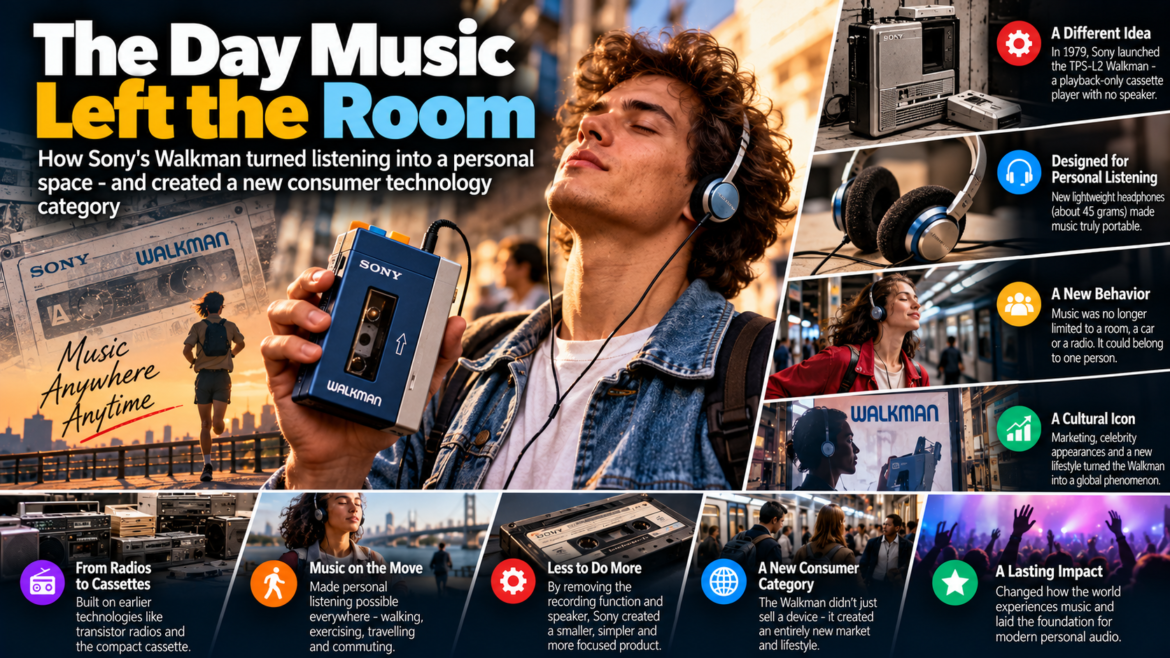
How Sony’s Walkman turned listening into a personal space – and created a new consumer technology category
A music player with something missing
In 1979, Sony introduced a strange-looking product that seemed to violate the logic of the portable cassette recorder. It could play music, but it could not record it. It had no built-in speaker. Instead, it came with lightweight headphones and was designed to be carried around.
Inside Sony, there were obvious objections. Why would anyone buy a tape machine that could not record? Sony’s own historical account says the company faced doubts that a playback-only machine could sell, while the first production run was set at 30,000 units – a large commitment for a new category.
The product was the TPS-L2, introduced in Japan on July 1, 1979.
It became the Walkman.
The important invention was not the cassette player itself. Portable radios and cassette technology already existed. The breakthrough was deciding that music did not have to belong to a room, a car, a stereo system or an audience. It could belong to one person.
The problem Sony noticed was not technical
Before the Walkman, people could already listen to music outside the home. Transistor radios had made broadcasting portable, and compact cassettes had made recorded music easier to carry. The Smithsonian traces portable entertainment through transistor radios in the 1950s and Philips’ compact cassette introduced in 1962.
But those technologies still left a gap.
A radio gave you whatever the broadcaster was transmitting. A home cassette system gave you personal choice, but the system lived in the home. A car stereo made music mobile, but the car defined the listening environment.
Sony’s insight was to combine existing technologies around a new behavior: personal listening while moving.
That sounds obvious today because billions of people have spent decades carrying music in their pockets. In 1979, it was a new category of consumer behavior.
The product was assembled from ideas Sony already had
The Walkman was not a completely new technological stack.
It took the compact cassette, miniaturized tape-player electronics and combined them with a new generation of lightweight headphones. Sony’s historical account says Masaru Ibuka became interested in a portable stereo for travel, while Akio Morita recognized the broader consumer potential and pushed for commercialization.
The headphones were particularly important. Sony says the conventional headphones of the period could weigh 300 to 400 grams, while the new MDR-3L2 headphones designed for the Walkman weighed about 45 grams.
That detail reveals the real design challenge.
The Walkman did not become portable simply because the cassette mechanism became smaller. The entire experience had to become portable – including the part that delivered the sound.
The missing features became the features
The most interesting decision was what Sony chose not to include.
The Walkman removed the recording function and the speaker from a conventional cassette recorder, replacing them with stereo playback and headphone connections. Sony later described this simplification as central to the product concept.
That changed the economics and the experience at the same time.
Without a speaker, the product did not have to project sound into a room. Without recording hardware, it could focus on playback. With headphones, the user could listen without asking anyone else to participate.
The product was therefore smaller not merely because of engineering, but because of a deliberate product decision: remove functions that were not necessary for the desired experience.
Sony was not selling a cassette player
This is where the Walkman’s marketing significance becomes more interesting than its engineering.
Sony did not simply sell the device as a smaller tape recorder. It promoted a lifestyle around it – music while walking, exercising, travelling and moving through the city.
Sony’s own 20th-anniversary history describes the Walkman as creating a new culture of enjoying music ‘anywhere and anytime,’ and notes that celebrity appearances and advertising helped turn the product into a cultural icon among young users.
The distinction is crucial.
People rarely become emotionally attached to a specification. They become attached to what the product allows them to do.
The Walkman sold freedom from the room.
The market initially had no name for what Sony had created
One of the most revealing details in the Walkman story is the name itself.
Sony’s internal history says the name ‘Walkman’ came from a young marketing employee who was inspired by Sony’s existing ‘Pressman’ product and the familiar idea of ‘Superman.’ Some colleagues thought the English word sounded strange. Akio Morita supported the name anyway.
When Sony first launched the product overseas, the name changed by market. It was called Soundabout in the United States, Stowaway in the United Kingdom and Freestyle in Australia before Sony eventually standardized ‘Walkman’ worldwide. Sony records that the word entered the Oxford English Dictionary in 1986.
That evolution is a useful branding lesson: a category-defining product sometimes needs a word before consumers can fully describe the behavior it creates.
The breakthrough was behavioral, not technical
The Walkman changed the relationship between people and their surroundings.
A commuter could create a private soundtrack inside a crowded train. A jogger could carry music outdoors. A traveller could take a personal collection on a journey. Two people could even listen together using the first model’s two headphone jacks.
The Smithsonian notes that cassette players made it possible for listeners to become their own deejays by choosing or creating mix tapes.
This introduced an important new layer of personalization.
The user was no longer just choosing whether to listen. The user could choose what to listen to, when to listen and, through tapes, how to sequence the experience.
Music became portable, personal and programmable.
The Walkman created a new kind of consumer technology
Sony’s first model was not simply followed by a few improved versions. It became a platform for an entire product category.
Sony expanded the concept through smaller cassette players, sports-oriented models, CD players, MiniDisc devices and later digital Walkman products. The company’s historical records document the transition from cassette Walkman to the portable CD player D-50 in 1984, DAT Walkman in 1990, MiniDisc Walkman in 1992 and later networked and flash-memory products.
The underlying idea stayed remarkably stable while the storage medium changed.
That is one sign of a strong product concept: the technology evolves, but the user promise survives.
The business model was bigger than the hardware
The Walkman was sold as hardware, but its commercial impact extended across an ecosystem.
Portable listening increased the value of recorded music that consumers already owned or purchased. Cassette sales, blank media, headphones and later CDs, MiniDiscs and digital music all became part of the portable listening economy.
The device also strengthened Sony’s broader position in consumer electronics by associating the company with miniaturization, design and personal entertainment.
Sony’s 1999 figures illustrate the scale of the phenomenon: by the end of fiscal 1998, cumulative worldwide shipments had reached 186 million cassette Walkman units, 46 million CD Walkman units and 4.6 million MiniDisc Walkman units.
The larger lesson is that a successful hardware product can create value by changing consumption behavior, not merely by selling more units.
The Walkman also changed the meaning of headphones
Before personal audio became mainstream, headphones were largely associated with specialized listening. The Walkman made them part of everyday life.
Sony’s own history highlights the parallel development of lightweight headphones as an essential part of the product. The Smithsonian collection preserves the original TPS-L2 with its associated MDR-3L2 headphones, showing how tightly the two were conceived as a single experience.
That relationship eventually became an enormous consumer category of its own.
Headphones evolved from simple accessories into products with their own design language, brands, premium pricing, noise cancellation and wireless connectivity.
The Walkman helped normalize the idea that the listener’s ears could become a private interface to the world.
A new market creates new problems
The Walkman’s success also changed the cultural conversation around portable audio.
If music could follow people everywhere, what happened to awareness of the environment? What happened when people could create an acoustic bubble around themselves?
These were early versions of questions that later surrounded smartphones, earbuds and always-connected devices.
The technology did not simply solve a problem. It created a new behavior, and that behavior introduced new trade-offs.
That is a recurring feature of transformative consumer technology: once convenience becomes normal, society starts negotiating its side effects.
Why the Walkman matters in the smartphone era
It is easy to look back at the cassette Walkman as obsolete hardware. That misses the more important story.
The Walkman established a design principle that survived multiple generations of technology: personal media should travel with the individual.
The iPod did not invent that expectation. Smartphones did not invent it either. Streaming services did not invent it.
They inherited it.
The Walkman helped teach consumers that entertainment could be selected, carried and consumed privately wherever they went.
The medium changed from tape to disc to digital file to cloud stream. The behavioral expectation remained.
The lesson for today’s product builders
The Walkman’s most useful lesson is not ‘make things smaller.’ It is ‘design around the behavior you want to create.’
Sony took existing technologies and removed enough friction to make a new activity feel natural.
The company also made a counterintuitive choice: it removed capabilities. No recording. No speaker. Just playback, portability and headphones.
That is an important product-management lesson in an era when features are often added faster than they are removed.
A product can become more valuable when it does fewer things exceptionally well.
The Walkman also demonstrates the power of lifestyle positioning. Sony was not merely explaining how the device worked. It was showing consumers who they could become with it: mobile, independent and surrounded by their own soundtrack.
That is where product design and marketing meet. The strongest consumer products do not merely fit into existing behavior. They give people a new behavior worth adopting.
Conclusion: The product that taught us to carry a world inside our ears
The Walkman did not invent recorded music. It did not invent headphones. It did not invent portable electronics.
Its breakthrough was combining existing technologies around a new idea of personal space.
In 1979, Sony took music out of the room.
Then it put the room inside the listener’s headphones.
The technology changed repeatedly over the decades, but the promise survived: your music could go wherever you went.
That is why the Walkman deserves to be remembered not merely as a famous Sony product, but as a landmark in consumer technology. It helped establish a pattern that now feels completely natural – entertainment should be personal, portable and available on demand. The modern smartphone, wireless earbud and streaming subscription may look radically different from a blue cassette player with orange foam headphones. But they are descendants of the same idea.