
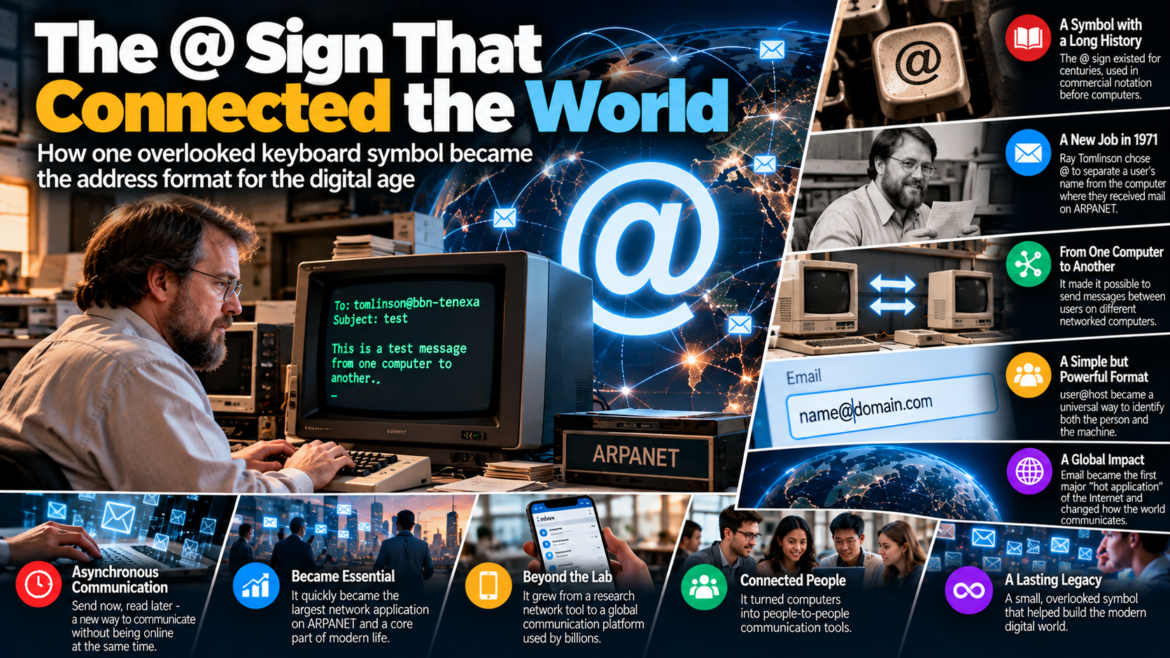
How one overlooked keyboard symbol became the address format for the digital age
A tiny symbol with a very large job
Look at almost any email address and you will see the same small character: @. It is so familiar that most people no longer notice it. Yet the symbol was not designed for email, and its modern importance was almost entirely accidental.
The @ sign had existed for centuries before computers. Merchants used it in commercial notation, and it appeared on some typewriters. But in 1971, computer engineer Ray Tomlinson gave it a new job: separating a person’s name from the computer where that person received mail over ARPANET, the research network that became a foundation of today’s Internet. The Smithsonian records Tomlinson choosing @ precisely because it was relatively uncommon in names and computer programs.
The character was ancient. The problem was new.
How do you send a message from one computer user to another user on a different computer?
Tomlinson’s answer became one of the most recognizable pieces of digital grammar ever created.
Email existed before the Internet
This story is often simplified into ‘Ray Tomlinson invented email.’ The historical reality is more interesting.
Electronic messaging systems existed before network email. The Internet Society notes that early programs allowed users to leave messages for other users on the same computer. What changed with ARPANET was the ability to send messages between users on different networked computers.
That distinction is crucial.
The basic idea of leaving a digital message was not new. The breakthrough was turning messaging into a network service.
Once people could send information to a person rather than merely to a location on the same machine, communication started to detach from physical proximity.
The network was built for computers, not conversation
ARPANET began as a research network connecting geographically separated computers. By the end of 1969, four host computers were connected, and the network continued expanding through the early 1970s.
Its early purpose was not to become the world’s messaging system. Researchers were trying to make computers and networks communicate reliably across distance.
But networks become useful in ways their architects cannot always predict.
Once researchers were connected, they needed ways to coordinate. They needed to tell one another things. They needed to move information quickly.
Email emerged from that human need sitting on top of the technical infrastructure.
The problem Tomlinson had to solve
A local mailbox was easy to imagine: user A leaves a message for user B on the same computer.
Network mail was different. The system needed to identify two things at once: the recipient and the machine responsible for that recipient’s mailbox.
Tomlinson needed an address format that could express both pieces without ambiguity.
His solution was remarkably simple: user@host.
The @ symbol became the divider.
The Smithsonian’s account of Tomlinson’s work describes his search for a character that was not widely used in programming or names. He found @ on the Model 33 Teletype keyboard he was using.
It was not a grand branding exercise. It was interface design under constraint.
The first network email was almost forgettable
Tomlinson sent the first network email to himself between two computers in his office. Even he later said he did not remember the exact contents of the message.
That forgotten sentence may be one of technology history’s most revealing details.
The important innovation was not the message’s content. It was proving that a person on one machine could address a person on another machine through the network.
The first email did not need to be profound. It needed to work.
From experiment to essential application
Once email worked across the network, it spread quickly because it solved a problem researchers immediately understood.
The Internet Society’s history records that electronic mail was introduced as the first major ‘hot application’ of ARPANET in 1972. Ray Tomlinson wrote the basic send-and-read software in March, and Larry Roberts later expanded the system with functions such as listing, selectively reading, filing, forwarding and responding. Email became the largest network application for more than a decade.
That sequence reveals a recurring pattern in technology.
The infrastructure comes first. Then someone discovers the application that makes people care.
For ARPANET, email was that application.
The killer feature was not speed. It was asynchronous communication
Email changed communication because people did not have to be available at the same time.
A phone call required both parties to participate simultaneously. A letter required physical delivery. Email created a third model: send now, read later.
That sounds ordinary because modern work is built around it. But asynchronous communication fundamentally changed how distributed teams, businesses and institutions could operate.
People could work across time zones without arranging a shared moment. Information could be forwarded, archived and searched. Conversations could leave a record.
The network was becoming a memory as well as a communication channel.
The @ sign became a piece of digital grammar
The remarkable thing about @ is that it did not merely become a popular symbol. It became syntax.
user@domain tells a computer and a human how to interpret an address. The symbol separates identity from location.
That pattern later became useful far beyond email. Social platforms adopted @ for usernames and mentions. Businesses incorporated it into digital branding. The symbol became shorthand for digital identity and online presence.
The Smithsonian notes that the symbol’s modern electronic life eventually extended into email addresses and social-media handles, turning an obscure commercial character into a defining mark of digital communication.
This is a rare kind of design success: a character people can type without thinking, yet one that carries structural meaning.
The business world discovered email
Email’s early users were researchers, but its value was not confined to research.
As networking spread from research institutions into universities, government environments and eventually commercial services, email became a general-purpose communication layer.
DARPA’s history of ARPANET documents the transition from a government-backed research network toward broader academic and commercial connectivity. It notes that MCI Mail became connected to the computer-based Internet after receiving authorization in 1988, and commercial Internet services expanded rapidly afterward.
This was the beginning of email’s transformation from a technical convenience into business infrastructure.
The business model did not need to be embedded in the original invention. Email became valuable because it reduced coordination costs for organizations.
Email changed the economics of distance
The telephone had already made real-time voice communication possible over long distances. The postal system had already made written communication geographically scalable.
Email combined some of the strengths of both while removing much of the waiting.
A company could send the same information to employees in different countries. A customer could contact a business without making an international call. Documents could be transmitted electronically rather than physically transported.
The impact was not simply faster communication. It was cheaper coordination.
When coordination becomes cheaper, organizations can change shape.
Teams can spread across locations. Suppliers can work across borders. Customer support can operate asynchronously. News can travel instantly. Entire industries can reduce the role of physical mail.
The hidden innovation: an addressable human
Perhaps email’s deepest contribution was changing what it meant to identify a person on a network.
Before network email, computers had identities. Users existed inside those computers.
The email address inverted the relationship.
A person could now have a network identity that was independent of physical location. The address could be written on a business card, printed on an advertisement and shared with anyone in the world.
That idea became a foundation for digital identity.
Today, an email address is used not only for communication but also for account creation, authentication, password recovery, receipts, subscriptions and business relationships.
A messaging address became a key that unlocks a large part of the digital economy.
Why email survived every wave of technology
Email has been declared obsolete many times.
Instant messaging was supposed to replace it. Social networks were supposed to replace it. Collaboration platforms were supposed to replace it.
Yet email persists because it is unusually universal.
It is not controlled by one social graph. Different organizations can exchange messages. People can move between services. Businesses can communicate with customers. Systems can send automated messages.
Its greatest strength is not that email is the best interface for every conversation. It is that email is a common communication layer between systems that do not otherwise have to belong to the same platform.
That makes email less like a social network and more like infrastructure.
The business model that grew around a protocol
Email also demonstrates an important technology-business principle: the most valuable layer is not always the layer that makes the first invention.
The core concept of network email was developed within a research environment. Later businesses built services around it: hosted mailboxes, enterprise email systems, spam filtering, security tools, marketing platforms, archiving, authentication, analytics and productivity software.
Entire industries emerged to help organizations manage a communication channel whose basic protocol was already widely shared.
This is similar to what happened with the Web and Internet protocols: open infrastructure can create enormous commercial opportunity above the protocol layer.
The economic value is often captured by convenience, reliability, security, distribution and workflow – not necessarily by owning the underlying standard.
The cost of success: inbox overload
Every technology that removes friction eventually creates a new form of friction.
Email made communication dramatically easier. That meant communication could also become dramatically more abundant.
The inbox became a queue of work. Businesses discovered email marketing. Spam became an industry. Security teams had to fight phishing and malware. Employees began spending large portions of their working day processing messages.
This is not a failure of the original idea. It is a predictable consequence of making a scarce resource abundant.
When communication was expensive, people had to be selective. When sending a message became nearly free, the cost shifted from the sender to the receiver.
The lesson for AI and today’s platforms
Email’s history offers a powerful lesson for today’s AI builders.
The breakthrough was not simply creating a faster way to send text. It created a standardized addressable system that other people and organizations could build on.
AI systems are now developing similar layers: APIs, model interfaces, agent protocols, identity systems and tool ecosystems.
The biggest opportunity may not belong only to the company that builds the smartest model. It may also belong to the companies that make intelligent systems interoperable, addressable and easy to integrate.
Email shows what happens when a simple convention becomes universal.
Once everyone agrees on how to address the message, an enormous ecosystem can grow around the message.
Conclusion: The symbol hiding in plain sight
The @ sign looks like punctuation.
In the digital world, it is much more.
It separates a person from a machine. It turns a name into an address. It helped transform a network of computers into a network of people.
Ray Tomlinson did not invent communication, and he did not invent the Internet. He solved a small coordination problem inside an emerging network.
But that small solution became part of the grammar of modern life.
The lesson is bigger than email.
Transformative technology often begins with a deceptively narrow question: how do we make two things that currently cannot find each other, talk to each other?
Solve that problem simply enough, and the solution can become infrastructure. Sometimes the most important inventions are not the spectacular machines. They are the tiny conventions that teach an entire world how to connect.