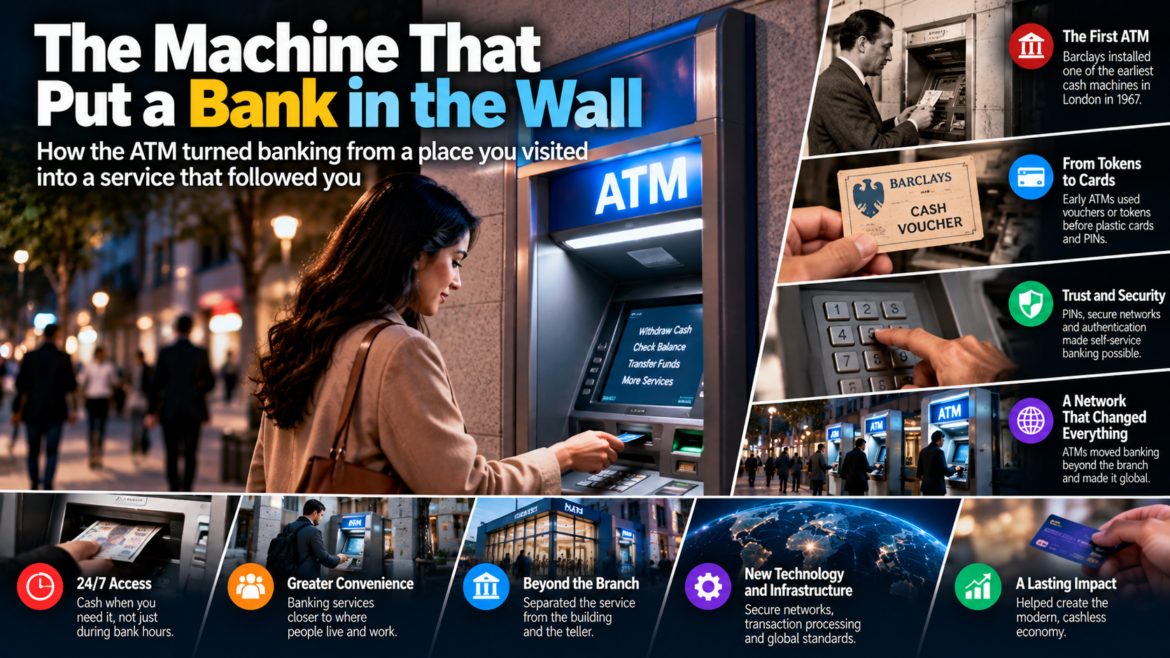
How the ATM turned banking from a place you visited into a service that followed you
The strange machine outside the bank
Imagine walking up to a machine outside a bank in 1967 and being asked to trust it with something precious: your money.
There was no teller behind the glass. No familiar face. No cash drawer. You inserted a special token, followed a sequence of instructions and waited for the machine to decide whether you should receive cash.
Today, the scene is so ordinary that we barely notice it. But the automated teller machine was once a radical proposition. It asked customers to accept a machine as a temporary substitute for a bank employee – and it asked banks to rethink one of their most fundamental assumptions: that banking required a human being at a counter.
The first generation of cash machines emerged from several overlapping inventions and experiments, so there is no single uncontested ‘inventor of the ATM.’ The Smithsonian’s history of the technology describes its invention as colorful and contested. What is clear is that Barclays installed John Shepherd-Barron’s cash machine at its Enfield branch in London in June 1967, creating one of the earliest successful bank cash-dispensing services.
The problem was bigger than getting cash
The obvious problem was inconvenience. Banks had opening hours. Customers needed cash outside those hours.
But the deeper problem was access.
A bank branch concentrated financial service in a physical location. If the branch was closed, the service effectively disappeared. The ATM began separating the service from the employee and the building.
That distinction is important because many transformative technologies begin by changing where a service can happen. The telephone removed distance from conversation. The internet removed geography from information. The ATM began removing the branch from everyday cash access.
This was not yet digital banking. It was something more fundamental: banking becoming available through a machine.
A machine born from several ideas
The history of the ATM is more complicated than the familiar story of one inventor having one sudden idea.
John Shepherd-Barron, working in the United Kingdom, became associated with the first widely recognized cash-dispensing machine after developing an idea for an automated system that could distribute banknotes. Barclays installed the machine in Enfield in 1967. Early machines used specially issued vouchers or tokens rather than the magnetic-stripe bank cards customers use today.
Other engineers and companies were pursuing related approaches around the same period. The Smithsonian’s historical treatment emphasizes that the ATM evolved through multiple experiments and technical contributions rather than a single clean invention story.
That messy history actually makes the story more useful. The ATM was not one brilliant object. It was an emerging system.
Why the first machines looked nothing like today’s ATMs
Modern users associate an ATM with a plastic card, a PIN, a screen and a cash slot. Early machines had a very different interface.
The challenge was not merely dispensing notes. A useful machine needed a way to identify the customer, authorize a transaction, record it and deliver the correct amount of cash.
The development of personal identification numbers became an important part of this evolution. The history of the ATM, documented by the Smithsonian, includes the emergence of the PIN as one of the technology’s foundational innovations.
In other words, the ATM was an early exercise in designing a trusted self-service experience. The machine had to convince an ordinary person that a sequence of mechanical and electronic actions could safely replace a human interaction.
The real breakthrough was trust
This is the part of the ATM story that is easy to overlook.
The machine itself was not the product. Trust was.
A bank could not simply place a cash dispenser on a street corner and expect customers to use it. Customers needed confidence that the machine would give them the right amount of money. Banks needed confidence that the person requesting the money was authorized. Both sides needed records of what had happened.
The ATM therefore forced banking to build a new layer between customer and institution: authentication, transaction processing, physical security, electronic communication, and increasingly standardized networks.
That infrastructure became more important as machines spread. What began as an automated cash drawer gradually became a connected terminal to a customer’s bank account.
The network changed everything.
A single ATM was useful. A network of ATMs was transformative.
Once machines could communicate with banking systems and customers could use cards beyond their home branch, the geographic relationship between a person and a bank began to weaken.
The customer no longer had to ask, ‘Where is my branch?’ The more useful question became, ‘Where is the nearest machine?’
That is a classic network effect. Every additional machine increased the practical value of the system to customers. Every additional customer gave banks a stronger reason to deploy more machines.
The ATM therefore became part of a broader transformation in payments infrastructure rather than remaining a standalone piece of hardware.
Self-service became a business model.
The ATM also changed the economics of banking operations.
A human teller could serve only a limited number of customers at a time and required a staffed branch. A machine could perform standardized transactions repeatedly without a teller standing beside it.
That did not make branches obsolete. Instead, it changed what branches and employees could be used for.
Routine cash withdrawals and balance inquiries could increasingly be handled by machines, while more complex financial conversations could remain with employees.
The broader business-model lesson is powerful: automation does not always mean replacing an entire service. Often it means separating the simple part of the service from the valuable human part.
The ATM survived the rise of the cashless economy
There is an apparent contradiction in the ATM’s history. The technology was created to make cash more accessible, yet modern payment systems have steadily made cash less central in many economies.
That has not made the ATM irrelevant.
The Federal Reserve’s payments research has continued to track ATM withdrawals as an important part of the U.S. payments system. Its 2019 study reported about 5.1 billion ATM cash withdrawals in the United States in 2018, worth roughly $0.80 trillion. The number of withdrawals had declined from earlier years even as the value of withdrawals increased. citeturn0search8
The point is not that ATMs are growing forever. It is that infrastructure can remain useful even when the behavior around it changes.
The ATM moved from being an exotic invention to ordinary infrastructure – precisely because it solved a problem so consistently that people stopped thinking about the technology.
From cash dispenser to banking terminal
The ATM eventually became capable of much more than dispensing notes. Depending on the machine and bank, customers could check balances, transfer funds, deposit money, change PINs and perform other account transactions.
The Federal Reserve’s regulatory definition reflects this broader evolution: an ATM is an electronic device through which a person can perform specified account transactions, including deposits and withdrawals, rather than simply a machine that dispenses cash.
This expansion illustrates another recurring pattern in technology. Once consumers learn to trust a new interface for one simple task, companies can gradually add more capabilities to the same interface.
The ATM as an early digital transformation
It is tempting to call the ATM a hardware innovation. But its deeper significance was organizational.
The machine changed who could perform a transaction, when the transaction could happen and where it could happen.
That is what digital transformation often looks like before it has a digital interface. The underlying innovation is not merely automation. It is the redesign of a process.
The ATM took a process that had traditionally required a person – identify customer, verify authority, access account, count cash, record transaction – and converted much of it into a repeatable self-service workflow.
Decades later, the same pattern would appear in online banking, mobile banking, airline check-in, e-commerce and digital customer service.
Why the ATM mattered to the modern fintech world
Fintech is often described as a recent phenomenon powered by smartphones, cloud computing and APIs. Historically, however, financial technology has repeatedly advanced by changing the interface between people and institutions.
The ATM was one of the earliest mass-market examples.
It demonstrated that consumers would trust technology to perform a financial transaction without direct employee involvement. It also demonstrated that a financial service could be distributed through a network of machines rather than a network of staffed locations.
That idea sits surprisingly close to the logic of today’s fintech platforms: move the financial service closer to the customer, reduce friction, automate routine work and use technology to make access continuous.
The lesson for today’s technology builders
The ATM offers a lesson that is easy to miss in an era obsessed with apps and artificial intelligence.
The winning innovation was not simply ‘a machine that dispenses cash.’ The breakthrough was redesigning an entire service around a new interface.
The machine succeeded because the surrounding system evolved with it: identification, authentication, transaction processing, banking networks, security procedures, regulation and customer habits.
That is why great infrastructure innovations are often harder to copy than they appear. A competitor can copy the visible machine. It is much harder to reproduce the network, trust and operating system behind it.
For today’s founders, the lesson is straightforward: if you are building a new interface, ask what invisible infrastructure must exist for customers to trust it.
Conclusion: The bank learned to leave the building
The ATM did something deceptively simple. It allowed a customer to access a bank account without entering a bank.
That small change weakened the physical boundaries of banking.
Over time, the same idea expanded from cash machines to cards, telephone banking, online banking and mobile apps. Each step moved another piece of the financial relationship away from the branch.
The ATM therefore deserves to be remembered not merely as the machine that gave us cash after hours, but as an early demonstration of a much larger idea: a service does not have to live where the institution lives.
Once customers learned that banking could come to them, the door opened to the financial world we know today.