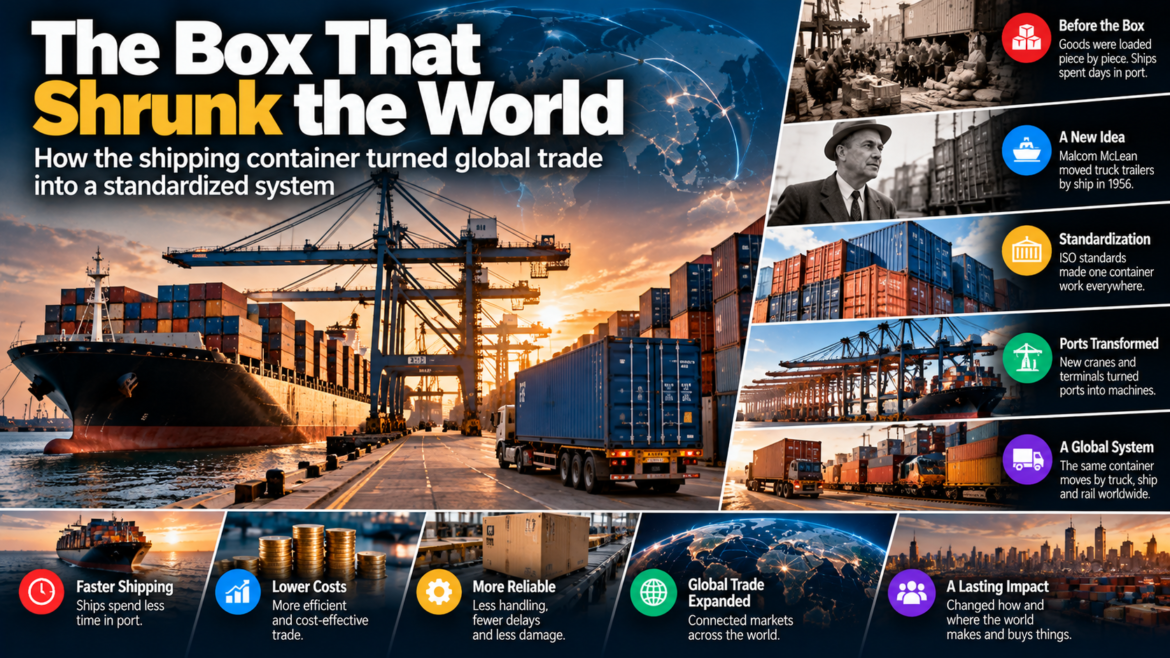
How the shipping container turned global trade into a standardized system
Before the box, ships were slow because the world was slow
For most of modern history, moving goods by sea meant moving the goods themselves – piece by piece. Cargo came to the dock in sacks, barrels, crates, bundles and wooden cases. Longshore workers carried, lifted, sorted and loaded those individual units into a ship’s hold. When the ship reached its destination, much of the process happened again in reverse.
The ship might spend days in port without moving an inch.
The ocean voyage was only one part of the journey. The real bottleneck was the transfer between modes: warehouse to truck, truck to dock, dock to ship, ship to dock, dock to rail or truck. Each handoff created time, labor, paperwork, damage and opportunities for theft.
Then someone asked a deceptively simple question: what if the cargo itself did not have to be handled at every stage?
The answer was a steel box.
Containerization did not invent the idea of putting goods into boxes. It created something much more consequential: a standardized box that could move from truck to ship to rail without unloading the goods inside. The Smithsonian describes this integrated system as the key breakthrough that transformed commercial shipping.
Malcom McLean saw the problem from the highway
Malcom McLean was a trucking entrepreneur, not a shipping magnate. That background shaped the way he saw freight.
In 1955, McLean acquired a steamship company. His idea was to move truck trailers by ship rather than repeatedly unload and reload their contents. The experiment evolved into the modern intermodal container system.
On April 26, 1956, the Ideal X, a converted tanker, sailed from Port Newark, New Jersey, to Houston carrying 58 containers. The Smithsonian identifies that voyage as the beginning of modern containerized transportation.
The important insight was not simply ‘put freight in a box.’ It was ‘make the box the unit of transport.’
That distinction changed everything.
The genius was standardization
A box is not revolutionary if every truck, train and ship requires a different box.
The real breakthrough was standardization.
If a container has predictable dimensions, standardized corner fittings and known weight limits, cranes can move it without caring what is inside. Trucks can carry it. Trains can carry it. Ships can stack it.
The cargo becomes almost irrelevant to the machinery moving it.
This is the same logic that made standardized electrical plugs, shipping pallets and computer interfaces powerful: the interface becomes predictable enough for different systems to work together.
The International Organization for Standardization created ISO technical committee ISO/TC 104 in 1961 to standardize freight containers. ISO explains that the committee standardized dimensions, stacking characteristics, securing mechanisms and terminology, with ISO 668 becoming a foundational standard for Series 1 freight containers.
In other words, the container revolution was as much a standards revolution as a steel-and-crane revolution.
The port became a machine
Once containers became standardized, the waterfront itself could be redesigned.
Traditional ports were organized around people handling individual pieces of cargo. Container ports required something different: enormous cranes, paved storage yards, specialized ships, rail connections, road connections and information systems.
The Smithsonian’s account of San Francisco and Oakland shows the consequences. Oakland had flat land and connections to road and rail infrastructure that made it well suited to containerization; San Francisco lacked those advantages and was quickly bypassed as the area’s primary port.
The container therefore did not simply improve an existing port. It changed which places could function as major ports.
That is a recurring infrastructure lesson: a new technology can change the geography of an industry because the infrastructure around the technology matters as much as the technology itself.
The hidden revolution was speed
The container’s most important benefit was not that steel boxes looked modern. It was that they changed the economics of time.
When cargo is handled individually, loading and unloading are labor-intensive and unpredictable. When standardized containers can be lifted mechanically, ships can spend far less time waiting for cargo operations.
The result is higher asset utilization: ships spend more time moving and less time sitting in port.
The World Bank notes that ports are critical nodes in global supply chains and that efficient container ports reduce delays, lower shipping costs and improve trade competitiveness. Its 2025 Container Port Performance Index continues to treat ship turnaround time as a core measure of port efficiency.
This is why containerization was not merely a logistics improvement. It changed the economics of distance.
It changed the cost of making things
Once the cost and complexity of moving goods fell, the geography of manufacturing could change.
A factory no longer had to be close to its final customers simply because transporting bulky cargo was expensive and unpredictable. Producers could locate where labor, materials, energy, skills or supplier networks made economic sense and then ship finished goods to distant markets.
ISO’s history of containerization makes the connection directly: standardized containers dramatically reduced shipping costs and helped countries that had previously been isolated from global trade put their products onto world markets.
This does not mean the container caused globalization by itself. Trade agreements, telecommunications, aviation, industrial policy, computing and cheaper energy all mattered. But containerization removed one of the physical frictions that had constrained global production.
The box did not create globalization. It made more globalization economically possible.
A painful transformation for dockworkers
Every efficiency revolution has winners and losers, and the container was no exception.
Containerization reduced the amount of manual cargo handling required in ports. That meant fewer workers were needed for many traditional longshore tasks.
The Smithsonian documents the labor conflict around San Francisco’s waterfront. In 1960, shipowners and longshoremen negotiated a contract to ease the transition, including compensation for workers affected by the new system. The waterfront workforce changed permanently.
This is an important reminder for modern technology debates. Productivity improvements are not socially neutral simply because they are economically valuable.
When a machine changes the number of people needed to perform a job, the economic gains and the human costs arrive together. The institutions that manage that transition – training, compensation, bargaining, education and regional investment – can determine whether technological progress becomes broadly beneficial.
The business model became a system, not a service
McLean’s innovation eventually grew into Sea-Land Service, but the larger transformation extended beyond one company.
Container shipping required coordination among shipowners, ports, trucking companies, railways, customs authorities, manufacturers and retailers.
That coordination created enormous economies of scale. Once a port had cranes and container yards, once railroads had intermodal terminals, and once ships were designed around standardized boxes, every additional container could move through a mature system more efficiently.
The business model therefore shifted from selling transportation as a series of disconnected steps to operating an integrated flow.
That idea should sound familiar to anyone working in technology today. Platforms become powerful when they standardize the interface between participants and make the whole network easier to use than the individual parts.
The container became the physical API of global trade
There is a useful modern analogy here.
A software API lets different systems communicate without each system needing to understand the internal details of the other.
The standardized container performs something similar in the physical economy.
A port crane does not need to know whether a container holds shoes, electronics or machinery. A train does not need to know which factory produced the goods. A truck does not need to open the box before moving it.
The standardized exterior becomes the interface.
That abstraction is one reason containerization was so powerful. It separated the identity of the cargo from the mechanics of moving it.
Why the world of e-commerce depends on a 1950s idea
When someone orders a product online today, the transaction looks digital. A customer taps a screen, payment is authorized and a tracking number appears.
But the product still has to cross a physical world.
Factories load goods into containers. Containers move through ports. Ships carry them across oceans. Trains and trucks carry them inland. Warehouses unpack and redistribute them.
The World Bank estimates that more than 80 percent of global merchandise trade by volume moves by sea, and a substantial share is carried in containers. The same institution’s 2023 Logistics Performance Index noted that, on average across trade routes, containers spent about 44 days from entering an export-country port until leaving the destination port, illustrating how much of international trade depends on physical logistics rather than digital transactions alone.
E-commerce did not eliminate geography. It built a digital interface on top of a containerized physical economy.
The container’s second revolution: information
A physical box is useful only if the network knows where it is supposed to go.
As container shipping scaled, documentation, scheduling, customs processes, tracking and port operations became increasingly important. The physical standard created the foundation; information systems made the network manageable at global scale.
That evolution continues today. The World Bank and International Association of Ports and Harbors have argued that digital collaboration across maritime supply chains can improve efficiency, resilience and environmental performance.
The pattern is striking: first standardize the physical object, then digitize the information surrounding it.
Many modern infrastructure systems follow the same sequence.
The unintended consequence: smaller prices, larger markets
The greatest impact of containerization may be something consumers rarely see: the price of distance fell.
When international shipping becomes cheaper and more predictable, products that were once too expensive to move across oceans become commercially viable in distant markets.
That expands consumer choice, encourages specialization and allows businesses to sell beyond their local geography.
ISO explicitly connects containerization with globalization and consumer choice, arguing that lower freight costs helped bring more products into more markets.
This is the deeper story behind the ordinary cardboard box arriving at a doorstep. The package is the final visible step in a logistics system whose economic foundations were transformed decades earlier.
But the box has a cost too
Containerization made trade dramatically more efficient, but efficiency is not the same as sustainability.
Modern shipping is a major source of greenhouse-gas emissions. The World Bank estimates that international shipping accounts for around 3 percent of global greenhouse-gas emissions and describes decarbonization as a major challenge for the industry.
The same infrastructure that made global trade cheaper also made it possible to move enormous quantities of goods around the planet.
That creates a modern dilemma: the next transformation in global logistics must preserve the benefits of standardization and scale while reducing environmental costs.
The container revolution solved the problem of moving goods efficiently. The next generation of logistics innovation must solve the problem of moving them efficiently and sustainably.
The lesson for today’s innovators
The shipping container offers a powerful lesson for technology, business and infrastructure leaders: sometimes the biggest innovation is not a new machine. It is a new standard.
The box became valuable because it created compatibility. Trucks, trains, ships, cranes and ports could all be designed around the same unit.
That compatibility created a network, and the network created scale.
The same principle appears in cloud computing, payment networks, USB standards, internet protocols and software APIs. The breakthrough often comes when competing systems can agree on a common interface.
For entrepreneurs, this suggests a useful question: what part of your industry is still being handled differently by every participant?
Standardizing that interface may create more value than inventing another feature.
Conclusion: The world was not made smaller. Moving through it became easier.
The shipping container is one of the least glamorous objects in the modern economy.
It is a steel rectangle. It has no screen, no processor and no famous consumer brand.
Yet it changed the physical architecture of globalization.
By turning cargo into a standardized unit, containerization reduced handling, accelerated ports, changed waterfronts, reshaped manufacturing geography and lowered the cost of reaching distant markets.
Its greatest achievement was abstraction: the contents could change, but the system did not have to.
That is why the container belongs in the history of transformative technology. It did not merely carry the products of globalization.
It helped make globalization economically practical.