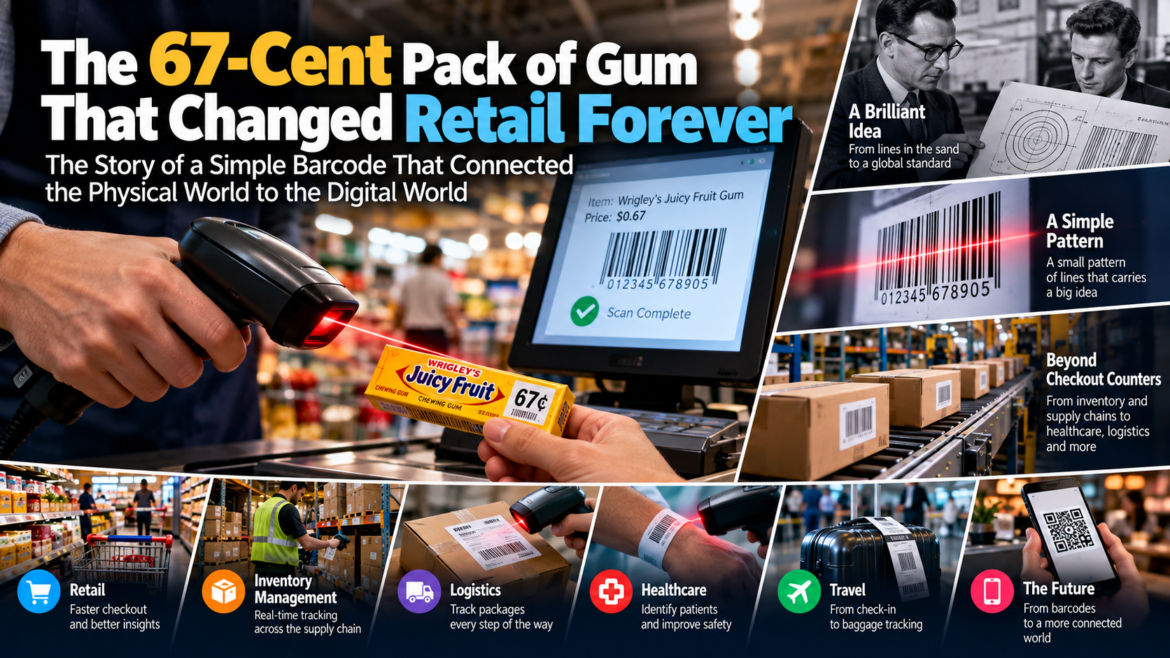
On June 26, 1974, a cashier in an Ohio supermarket scanned a pack of Wrigley’s Juicy Fruit gum. It cost 67 cents. The purchase took only a moment. But the beep that followed marked the beginning of a new kind of commerce – one in which physical products could carry a digital identity.
Today, that beep is almost invisible.
It happens when we buy groceries, ship a package, return a product, check into a hospital, board an aircraft, borrow a library book or move inventory through a warehouse.
The object in front of us is physical.
The information surrounding it is digital.
A small pattern of black lines became the bridge between the two.
That technology was the barcode.
And its importance goes far beyond faster checkout counters.
The barcode helped retailers understand what they were selling. It gave manufacturers a standardized language for identifying products. It allowed inventory to become measurable in real time. It laid foundations for modern supply chains, point-of-sale systems, logistics, analytics and eventually the QR-code-driven world we now take for granted.
The remarkable part is that the barcode wasn’t born from a grand vision of digital commerce.
It was born from a much simpler problem:
How can a supermarket identify a product quickly enough that a machine can handle the transaction?
The answer changed the global economy.
The supermarket had a problem
By the late 1960s, supermarkets were becoming enormous businesses.
Thousands of products sat on shelves.
Every item had to be priced.
Cashiers had to identify products and enter prices.
Retailers needed to know what had sold.
Manufacturers wanted to understand demand.
And inventory had to be managed across increasingly complex operations.
The checkout counter was therefore more than a place where customers paid.
It was a bottleneck where the physical world collided with information.
A cashier could see a can of soup.
The retailer’s computer needed to know:
Which product is this?
What does it cost?
How many were sold?
How many remain?
The problem was that computers didn’t understand cans of soup.
They understood data.
Someone needed to create a machine-readable bridge between the two.
The idea began in the sand
The story of the barcode goes back much further than supermarkets.
In 1948, graduate student Bernard Silver overheard a supermarket executive asking the dean of Drexel Institute of Technology to research a method for automatically capturing product information at checkout.
Silver discussed the problem with fellow graduate student Norman Joseph Woodland.
Woodland began thinking about how product information could be encoded in a form a machine could read.
According to GS1’s historical account, the breakthrough came while Woodland was staying with his grandparents in Miami Beach.
He drew lines in the sand.
The lines reminded him of Morse code.
The insight was simple:
If dots and dashes can represent information, perhaps lines can do the same thing.
It was an elegant idea.
But the practical technology needed to make it work didn’t yet exist.
The first barcode didn’t look like today’s barcode
Woodland and Silver initially developed a bull’s-eye design – concentric circles rather than the familiar vertical lines.
They patented the invention in 1952.
The patent described a system for encoding information visually so that machines could read it.
The Smithsonian’s National Museum of American History preserves Woodland’s papers and identifies Woodland and Silver as the inventors and developers of the barcode.
But having an invention was not the same thing as having a commercially viable system.
The technology required expensive equipment.
Printing was difficult.
Scanning technology wasn’t sufficiently practical.
The barcode would have to wait.
Sometimes the breakthrough is waiting for other technologies
This is one of the most interesting lessons in the story.
Woodland and Silver had the basic concept.
But the world wasn’t ready for it.
A commercially useful barcode required several technologies to mature simultaneously:
- Reliable printing
- Optical scanning
- Lasers
- Computing
- Affordable electronic hardware
- Standardized product identification
The idea existed before the ecosystem needed to support it.
This happens repeatedly in technology.
An invention can be technically correct but economically premature.
The breakthrough arrives when several independent technologies finally become good enough to work together.
The supermarket industry finally agreed on the problem
By 1970, the grocery industry had reached a point where it needed a common standard.
Retailers and manufacturers didn’t merely need a barcode.
They needed the same barcode system.
That distinction was critical.
Imagine if every supermarket used a different product-identification format.
A manufacturer would need different labels for different retailers.
Scanners would need different standards.
Software would need different databases.
The entire system would become fragmented.
The barcode therefore required something more important than technical ingenuity.
It required industry agreement.
The grocery industry formed an Ad Hoc Committee on a Uniform Grocery Product Code and began looking for a standardized machine-readable system.
That decision would prove as important as the invention itself.
IBM entered the race
IBM was among the companies asked to develop a practical solution.
IBM engineer George Laurer led the development effort.
The existing bull’s-eye concept had a serious problem.
It could smear when printed.
Laurer believed a different approach was necessary.
He developed the now-familiar rectangular pattern of vertical black bars.
IBM’s historical account describes Laurer’s design as a scalable, reliable alternative that could be read using laser scanning technology.
Woodland, by then an IBM employee, also contributed to the development.
The eventual result became the Universal Product Code – UPC.
The real breakthrough wasn’t the bars
At first glance, a barcode looks almost absurdly simple.
Black.
White.
Lines.
Numbers.
But the bars themselves weren’t the revolutionary part.
The real breakthrough was creating a standardized machine-readable identity for a physical product.
A barcode didn’t store the entire product description.
It provided a number.
The scanner could read that number.
The retailer’s computer could look up the corresponding product.
That separation was powerful.
The physical object carried an identifier.
The database carried the information.
This architecture would become fundamental to digital commerce.
April 3, 1973: the standard was born
On April 3, 1973, industry leaders adopted the Universal Product Code as the standard for identifying retail products in the United States.
GS1, which evolved from the organizations created around the standard, identifies this date as the birth of the barcode system that transformed retail.
This was the moment the barcode stopped being simply an invention.
It became infrastructure.
That distinction matters.
An invention can exist by itself.
Infrastructure requires adoption.
The UPC needed:
Manufacturers
→ printing the codes
Retailers
→ installing scanners
Technology companies
→ building point-of-sale systems
Standards organizations
→ assigning and managing numbers
Consumers
→ accepting the new checkout experience
Every part of the ecosystem had to move together.
Then came the beep
The first commercial barcode scan happened on June 26, 1974.
At a Marsh supermarket in Troy, Ohio, a cashier scanned a 10-pack of Wrigley’s Juicy Fruit gum.
The price was 67 cents.
The scanner read the UPC.
The register retrieved the corresponding product information.
The beep became one of the most important sounds in modern retail.
It is difficult to imagine a less dramatic-looking historical event.
No rocket launch.
No television audience.
No dramatic announcement.
Just a packet of chewing gum moving across a checkout counter.
But the implications were enormous.
The barcode changed what a checkout counter could do
Before barcodes, the checkout process depended heavily on human input.
A cashier needed to identify the product and enter information.
With a barcode scanner:
Scan → identify → retrieve → record
The process became faster and less dependent on manual data entry.
IBM’s history of point-of-sale systems describes how the UPC allowed scanners to identify products, retrieve prices and record sales information while reducing manual effort and errors.
But faster checkout was only the beginning.
The real revolution happened after the transaction.
Every sale became data
Imagine a supermarket before computerized scanning.
A product leaves the shelf.
A customer pays.
The retailer knows it has sold something.
But the information available from that transaction is limited.
With a barcode system, the retailer can associate the transaction with a specific product identifier.
Now the sale becomes data.
The retailer can begin asking:
- How many units sold?
- Which products sell fastest?
- Which store sells them?
- At what time?
- Which products are frequently purchased together?
- When should inventory be replenished?
The checkout counter became an information-generation system.
That was the deeper revolution.
Retailers stopped guessing about inventory
Before computerized scanning, inventory management could be slow and labor-intensive.
Barcodes made inventory increasingly measurable.
A product sold.
The system recorded it.
Inventory changed.
The retailer could use the information to replenish stock.
That created a feedback loop:
Sale → Data → Inventory update → Replenishment
The store became more responsive.
And as computer systems became more sophisticated, the information could move beyond individual stores.
The supply chain became visible
This is where the barcode escaped the supermarket.
A product doesn’t begin its life at the checkout counter.
It may move through:
Factory → warehouse → distributor → retailer → store → customer
If each stage can identify the product or shipment, information can travel with the physical object.
The barcode therefore became a language for supply chains.
GS1 describes the barcode as connecting physical products to digital identities and enabling information to be shared throughout the supply chain.
That is a much bigger achievement than speeding up checkout.
The barcode created a digital identity for physical things
This may be the most important idea in the entire story.
A physical object exists in the real world.
A database exists in the digital world.
The barcode connects them.
A bottle of shampoo isn’t digital.
But its identifier can be.
A carton isn’t digital.
But its movement can be recorded.
A shipment isn’t digital.
But its status can be tracked.
The barcode therefore created a simple bridge between:
Physical reality
and
digital information
That bridge became one of the foundations of modern commerce.
The business model was about standards, not selling stripes
The barcode’s economics are also interesting.
A barcode isn’t valuable because of the black lines themselves.
The value comes from the standard behind them.
Who owns this product?
Which company manufactured it?
Which number identifies it?
Is that number unique?
Can another retailer interpret it?
Can a supplier use the same identification system?
GS1 evolved into the global standards organization supporting these identification systems.
Today, GS1 describes EAN/UPC as the longest-established and most widely used family of GS1 barcodes.
This is a powerful business lesson:
Sometimes the most valuable technology is not the interface people see. It is the standard that makes everyone else’s systems interoperable.
Standardization created network effects
Imagine one retailer adopting barcodes.
Useful.
Now imagine thousands of retailers adopting the same system.
Much more useful.
Now manufacturers can print one standardized identifier.
Distributors can use it.
Logistics companies can scan it.
Retailers can recognize it.
Software systems can exchange the information.
The value increases as more participants adopt the same standard.
This is a form of network effect.
The barcode succeeded not because it was individually brilliant.
It succeeded because everyone could agree to use the same language.
The barcode didn’t eliminate people
There were concerns about automation and jobs.
Cashiers and labor unions worried that scanners could reduce employment.
Retailers, meanwhile, had to invest in expensive new equipment.
Manufacturers had to change packaging.
The system had to reach a critical level of adoption before its benefits justified the costs.
IBM’s history notes that retailers and manufacturers initially faced substantial implementation concerns and that the system needed broad adoption to become economically worthwhile.
This is a recurring pattern in technological transformation.
The value of infrastructure is often invisible until enough participants adopt it.
The chicken-and-egg problem
The barcode faced a classic platform problem.
Retailers didn’t want to install scanners if manufacturers weren’t printing barcodes.
Manufacturers didn’t want to print barcodes if retailers couldn’t scan them.
Who moves first?
This is one of the hardest problems in technology adoption.
Standards solve it partly by creating a common expectation.
Once enough major participants commit to a standard, the market can move together.
That is why industry coordination mattered so much.
The barcode changed the economics of information
Before the barcode, collecting information about physical products required substantial human effort.
After the barcode, the cost of identifying a product fell dramatically.
That changed what businesses could afford to measure.
And once the cost of measurement falls, companies tend to measure more.
This produces a familiar technological cycle:
Cheaper measurement → more data → better decisions → new business models
The barcode was one of the early technologies that helped initiate this process at massive scale.
From checkout to logistics
As barcode technology spread, it moved beyond retail counters.
Warehouses could scan inventory.
Factories could identify components.
Shipping companies could track packages.
Libraries could identify books.
Hospitals could identify medicines and supplies.
Airlines could process boarding and baggage information.
IBM notes that barcode systems eventually expanded into logistics, travel, healthcare and other industries.
The original problem was grocery checkout.
The solution became a general-purpose identification infrastructure.
Then the warehouse became intelligent
Consider a warehouse without machine-readable identification.
A worker sees a box.
The worker has to identify it.
The worker records its location.
The worker moves it.
Someone updates the inventory.
The process is slow and error-prone.
Now introduce barcodes.
Scan the box.
The system knows what it is.
Scan the shelf.
The system knows where it is.
Move the box.
The database can record the movement.
The warehouse becomes a physical manifestation of a database.
That concept would later become central to modern fulfillment centers.
E-commerce depended on this invisible layer
The rise of online shopping is often told as an internet story.
Websites.
Search engines.
Online payments.
Mobile phones.
Cloud computing.
But e-commerce also required something much less glamorous:
Knowing what physical products exist and where they are.
If an online retailer promises to ship a product, its system needs some way of knowing:
- What product is it?
- How many are available?
- Where is it stored?
- Has it been picked?
- Has it shipped?
- Which order does it belong to?
Barcode-based identification became one of the technologies that made this physical-digital synchronization practical.
The website is the visible interface.
The warehouse is the hidden engine.
The barcode connects them.
Amazon’s warehouse is a descendant of the supermarket scanner
This is an editorial interpretation rather than a claim that Amazon directly copied the original supermarket system.
But the conceptual lineage is clear.
The supermarket scanner established the idea that:
Every product can have a machine-readable identity that can be linked to a digital record.
Modern fulfillment systems take that idea dramatically further.
Products become digital records.
Locations become digital records.
Orders become digital records.
Movements become digital records.
Workers and machines interact with the system through scans and sensors.
The warehouse becomes an information system wrapped around physical objects.
The humble barcode was an early version of that architecture.
The barcode also changed marketing
This is where the story becomes particularly relevant to marketers.
Once every product could be identified consistently, retailers could connect purchases to product-level information.
That made it possible to understand demand with far greater precision.
Instead of asking:
“Are people buying groceries?”
retailers could ask:
“Which brand of cereal sells most strongly on Saturday mornings?”
Or:
“Which promotion changes purchasing behavior?”
Or:
“Which products are frequently purchased together?”
The barcode therefore became part of the infrastructure behind modern retail analytics.
Marketing became increasingly measurable.
The product became trackable through its lifecycle
The barcode also changed the idea of a product’s lifecycle.
A product could be:
Manufactured
→ Packed
→ Shipped
→ Received
→ Stored
→ Sold
→ Returned
Each event could potentially be associated with the same product identifier.
That creates something powerful:
Traceability.
Traceability is now critical in industries such as food, pharmaceuticals, healthcare and manufacturing.
The healthcare connection is especially important
A barcode on a grocery product seems trivial.
A barcode on a medication can be a matter of safety.
Healthcare organizations can use standardized identification systems to identify products, medicines and other items.
The broader principle remains the same:
Know exactly what the physical object is.
When the cost of mistakes is high, machine-readable identification becomes much more than a convenience.
It becomes a control mechanism.
The barcode created the foundation for QR codes
The barcode didn’t disappear when QR codes arrived.
Instead, the underlying idea evolved.
A traditional one-dimensional barcode typically carries a relatively limited amount of information.
Two-dimensional codes can encode substantially more data and can be scanned by smartphones.
GS1’s current strategy increasingly incorporates QR codes and its GS1 Digital Link standard, which can connect products to web-based information such as product details, ingredients, promotions and other data.
The underlying philosophy remains unchanged:
Give physical things a machine-readable digital identity.
The interface simply became more powerful.
The next generation is already arriving
GS1 has been working with industry toward broader adoption of two-dimensional barcodes at retail points of sale.
Its stated ambition is for QR codes and GS1 DataMatrix barcodes to become readable at retail points of sale around the world by the end of 2027.
That could create a new generation of product interactions.
A consumer could scan a product with a smartphone and potentially access:
- Product information
- Ingredients
- Authenticity information
- Promotions
- Instructions
- Sustainability information
- Recall information
- Digital experiences
The barcode could therefore evolve from:
“What is this product?”
to:
“Tell me everything I need to know about this product.”
From identification to intelligence
This is where the story becomes particularly relevant to AI.
A barcode identifies an object.
A database gives it context.
Analytics identifies patterns.
AI can interpret those patterns.
Imagine a supply chain in which every product has a digital identity and every movement generates data.
AI can potentially use that information to predict:
- Demand
- Stock shortages
- Delivery delays
- Product defects
- Supply chain disruptions
- Consumer behavior
The barcode itself isn’t intelligent.
But it helps create the data infrastructure that makes intelligent systems possible.
What the barcode teaches today’s entrepreneurs
The story offers several lessons.
1. Solve the boring problem
The barcode wasn’t glamorous.
It solved checkout.
But checkout was a massive problem occurring millions of times.
Small friction multiplied across billions of transactions becomes a huge opportunity.
2. Standards can be more powerful than products
A product can win customers.
A standard can connect industries.
3. Infrastructure often looks insignificant
A barcode is visually simple.
Its economic impact is anything but simple.
4. Reduce the cost of information
When information becomes cheaper to collect, entirely new business models become possible.
5. Design for ecosystems
The barcode only became powerful when manufacturers, retailers and technology providers adopted the same system.
6. Make physical things digitally visible
One of the defining trends of modern technology is turning the physical world into machine-readable data.
The barcode was an early and enormously successful example.
The most important innovation wasn’t the scanner
It is tempting to tell the barcode story as a hardware story.
Scanner.
Laser.
Computer.
Register.
But the more important innovation was the system.
A standard number.
A printed symbol.
A scanning mechanism.
A database.
A point-of-sale terminal.
A retailer.
A manufacturer.
All connected.
That is why the barcode survived and expanded.
It wasn’t simply a clever pattern.
It was a common language.
A 67-cent purchase became a global infrastructure
Think again about that first scan.
A cashier.
A supermarket in Troy, Ohio.
A packet of Wrigley’s Juicy Fruit.
67 cents.
A laser.
A beep.
Then the next product.
And the next.
Over time, the same basic idea moved through warehouses, factories, hospitals, airlines, libraries and global supply chains.
GS1 says that by 2023, more than 1 billion products carried GS1 barcodes and that barcodes were being scanned billions of times every day around the world.
The scale is difficult to comprehend.
Yet the interface remains almost exactly what it was designed to be:
Something a machine can read quickly and reliably.
The barcode changed something deeper than checkout
Before the barcode, a product was primarily a physical object.
After the barcode, the product increasingly became:
Physical object + digital identity.
That combination changed retail.
It changed logistics.
It changed inventory.
It changed manufacturing.
It changed marketing.
It changed consumer information.
And it helped create the foundation for the highly digitized supply chains we now depend on.
The barcode’s genius was its modesty.
It didn’t attempt to replace the physical world.
It simply gave the physical world a language computers could understand.
The lesson for the AI era
Today’s technology industry is obsessed with increasingly sophisticated systems.
Generative AI.
Agents.
Robotics.
Autonomous vehicles.
Predictive analytics.
But all of these systems need something fundamental:
Reliable data about the world.
AI cannot intelligently manage inventory if it doesn’t know what the inventory is.
A robot cannot reliably move an item if the system doesn’t know which item it is.
A retailer cannot accurately forecast demand if product information is inconsistent.
An AI-powered supply chain cannot optimize objects it cannot identify.
That makes the barcode’s original idea surprisingly relevant today.
Before machines can intelligently reason about the physical world, they need a way to recognize it.
The barcode was one of humanity’s earliest scalable answers to that problem.
The beep that made the physical world searchable
The barcode is easy to overlook because it became so successful.
It doesn’t demand attention.
It doesn’t have a screen.
It doesn’t speak.
It doesn’t look futuristic.
It simply sits quietly on the back of a product.
But behind those lines is a remarkable idea:
Give every physical object an identity that a machine can recognize.
Once that happens, the object can enter a digital system.
Once it enters a digital system, it can be counted.
Tracked.
Analyzed.
Moved.
Sold.
Reordered.
Verified.
Optimized.
And eventually, understood by machines.
That is why the barcode deserves to be remembered as more than a retail convenience.
It was one of the earliest bridges between the physical and digital economies.
And on June 26, 1974, that bridge carried its first passenger:
a 67-cent pack of chewing gum.