
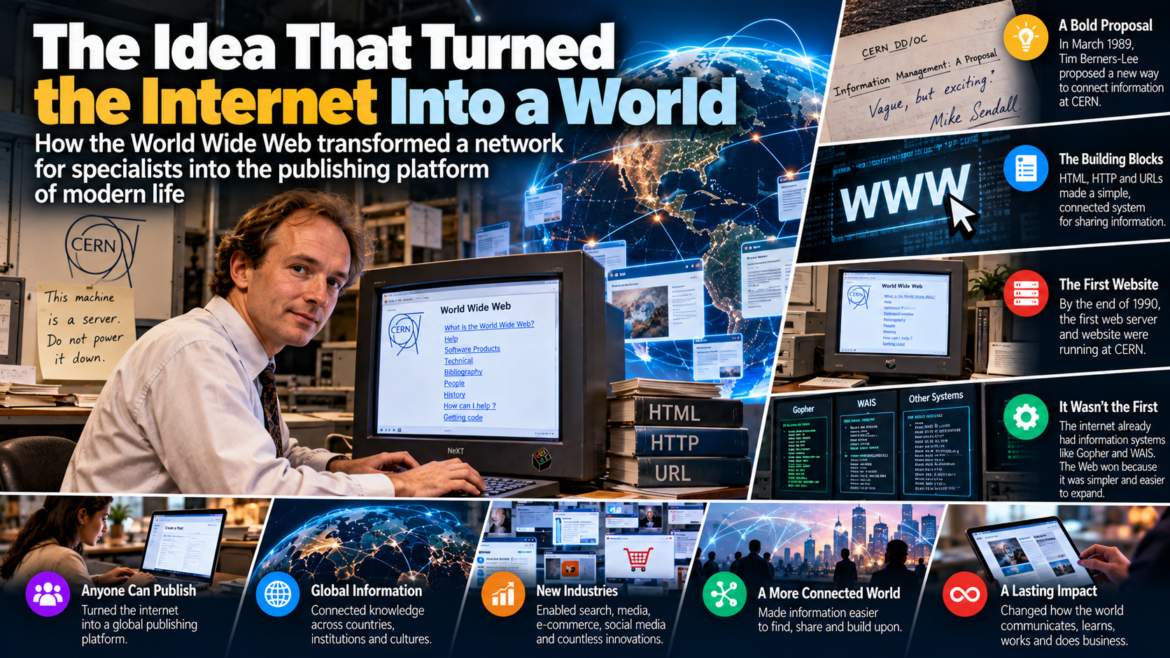
How the World Wide Web transformed a network for specialists into the publishing platform of modern life
The note on the door
There was a small warning attached to a computer at CERN in Switzerland: this machine was a server. Do not power it down.
The computer was a NeXT workstation sitting in Tim Berners-Lee’s office. It was not a giant data center. It was not the beginning of a consumer technology company. It was one computer running the first web server – an almost absurdly modest starting point for a technology that would eventually become the publishing, commerce, media and communication layer of the modern world. CERN records that the first web server and the first website were running there by the end of 1990.
The internet already existed. Networks could already move information between computers. Researchers already had email, file transfer and other information-retrieval systems.
What was missing was a simple way to connect information so that an ordinary user could move from one document to another without needing to understand the machinery underneath.
Berners-Lee’s breakthrough was not inventing the internet. It was creating a layer that made the internet easier to use, easier to publish on and, crucially, easier to expand.
The problem was information trapped in silos
Berners-Lee was working at CERN, an international scientific laboratory where researchers from universities and institutes around the world needed to share information. CERN describes the original motivation directly: the Web was conceived to meet the demand for automated information-sharing among scientists working across different institutions and countries.
The problem was not a lack of information. There was too much of it, scattered across different computers and systems.
A document could exist somewhere on the network, but finding it and understanding how it related to another document could be difficult. Researchers were using different machines, software and information systems.
Berners-Lee saw an opportunity to connect these islands through a common system based on hypertext – documents containing links that could lead to other documents.
The insight sounds obvious today because the Web made it normal. In 1989, it was a proposal for a different way of organizing knowledge.
March 1989: a proposal that was almost too vague
In March 1989, Berners-Lee wrote his first proposal for an internet-based hypertext system at CERN. CERN’s historical account records his manager Mike Sendall’s famous handwritten assessment on the proposal: ‘vague, but exciting.’ The project was allowed to proceed.
That moment is worth pausing over.
The proposal did not describe social media, online shopping, streaming video, search engines or cloud software. None of those businesses existed in the document.
It described a system for linking information.
That is one of the defining characteristics of foundational innovation: the inventor may understand the mechanism long before society understands the scale of its consequences.
The three pieces that made the Web work
Berners-Lee did not simply create a new kind of document. He combined several ideas into a usable system.
The first was HTML – HyperText Markup Language – which provided a way to structure documents and create links between them.
The second was HTTP – the protocol used to request and transfer web resources.
The third was the URL, which gave resources addresses that could be referenced.
CERN and the World Wide Web Consortium both document these components as core elements of the early Web. By the end of 1990, Berners-Lee had created the first web server, browser and editor, alongside the early versions of HTML, HTTP and URLs.
The genius was not that any single component was magical. It was that they fit together.
The first website was almost comically simple
The world’s first website was dedicated to the World Wide Web project itself. It explained what the Web was, how to access documents and how to create a web server. It ran at CERN on Berners-Lee’s NeXT computer.
There was no homepage carousel. No advertising. No shopping cart. No social feed.
There was simply a set of instructions for joining the system.
In retrospect, that first website reveals something important about platform businesses: the earliest version of a platform often has to teach people how to participate in it.
The Web initially had to recruit not just readers, but publishers and server operators.
The Web was not the first way to use the internet
This is where the history becomes especially interesting.
The internet was already supporting information systems such as Gopher and WAIS. The Web won not because it was the first networked information system, but because it combined simplicity, hypertext linking and an architecture that was relatively easy to implement.
CERN explicitly notes that other internet-based information-retrieval systems existed at the time, but that the Web’s simplicity and royalty-free availability helped drive rapid adoption.
That is a major innovation lesson.
Technology does not always win by being the most technically sophisticated option. It can win by lowering the cost of participation.
1991: the invitation to ‘try it’
In 1991, Berners-Lee released the Web software beyond the immediate development environment at CERN. CERN’s history records that the software included a line-mode browser, server software and a library for developers; in August 1991, Berners-Lee announced the Web on internet newsgroups, spreading the project beyond CERN.
The wording of the invitation mattered. The Web was not presented as a finished commercial product. People were encouraged to experiment with it.
That created a different kind of growth loop.
One person could build a server. Another could write a page. A third could link to it. A fourth could create a browser improvement. Each new participant increased the usefulness of the whole system.
The Web was becoming a network not because one company controlled every node, but because a common set of rules allowed independent people and organizations to create new nodes.
The decision that changed the business model before there was a business
On 30 April 1993, CERN made the Web software available in the public domain and later made a release available under an open licence. CERN says these decisions allowed the Web to flourish.
This may have been the most commercially consequential decision in the Web’s early history precisely because it was not primarily a commercial decision.
CERN did not charge every future website for the privilege of using the underlying technology. It removed a major barrier to adoption.
That created an unusual economic foundation: the infrastructure could be free while businesses could compete above it.
Search engines could emerge. Publishers could build websites. Online stores could sell products. Advertising networks could monetize attention. Software companies could offer web applications.
The Web itself did not need to capture all of that value to become enormously important. It became the platform on which others could build.
The browser turns the system into a consumer experience
The early Web was still difficult for ordinary people. Browsers were evolving, computers were expensive and internet access was not yet universal.
Then graphical browsers began making the experience easier to understand.
The browser changed the Web from a technical system into a visual destination. Instead of thinking about protocols and servers, users could think in terms of pages, links and websites.
This is an important distinction: the Web was an infrastructure invention, while the browser became its consumer interface.
Once the interface improved, the audience could expand dramatically.
The Web changes what it means to publish
Before the Web, publishing at scale generally required access to printing presses, broadcast infrastructure, distribution networks or institutional gatekeepers.
The Web changed the economics of publishing.
A person with a computer and an internet connection could create a page that anyone else could access. A small company could publish globally without building a television network. A specialist could reach an audience without owning a newspaper.
The cost of creating and distributing information fell dramatically.
This did not eliminate gatekeepers. Search engines, social platforms, app stores, hosting companies and other intermediaries later became powerful gatekeepers of their own. But the underlying publishing model had changed.
The Web had made publishing addressable.
From pages to platforms
The first Web was mostly documents. The next Web became interactive.
Businesses began using websites for catalogs, customer service and commerce. Search engines helped people discover information. Online marketplaces connected buyers and sellers. Webmail turned the browser into an application interface.
The architecture was increasingly being used for something more ambitious than publishing pages: delivering services.
This was the moment the Web stopped being merely a digital library and became a general-purpose platform.
The distinction is crucial for understanding its business impact. A platform creates value not only through what its owner produces, but through what other participants can build on top of it.
Why openness became a competitive advantage
The Web’s open architecture did not guarantee that every company would behave openly. It did something subtler: it created a common technical space in which competing organizations could participate.
The World Wide Web Consortium, founded in 1994, was created to help maintain a consistent architecture as companies invested more heavily in the Web. W3C continues to describe open, royalty-free standards as a core part of its model.
That approach mattered because a website did not need to know which company made the user’s computer, which company provided the internet connection or which company hosted another website.
The common standards were the connective tissue.
This is one reason the Web became more than a product. It became an ecosystem.
The business model nobody had to invent
One of the Web’s most remarkable characteristics is that it did not arrive with a single business model.
The infrastructure was made freely available. Entrepreneurs then experimented above it.
Advertising became one model. E-commerce became another. Subscriptions, software-as-a-service, marketplaces, lead generation, digital publishing, affiliate commerce and data-driven services followed.
Some of the world’s largest technology companies would eventually build enormous businesses around web traffic, search, advertising, commerce and cloud infrastructure.
The Web therefore demonstrates a powerful platform principle: sometimes the best way to create an economic ecosystem is to make the underlying protocol widely available and compete on the services built above it.
That is an interpretation of the Web’s economic history rather than a claim that CERN deliberately designed a business ecosystem. The documented fact is simpler: CERN made the technology freely available, and independent organizations subsequently built an enormous commercial layer on top of it.
The Web becomes the operating layer of everyday life
The Web eventually moved far beyond the scientific information-sharing problem that inspired it.
It became a place to publish news, sell products, watch video, communicate, learn, advertise, manage businesses, apply for jobs, access government services and build communities.
W3C notes that Web standards have supported phenomena including social media, e-commerce, video on the Web and video conferencing, while its standards now underpin a huge ecosystem of websites and services.
The transformation was not caused by a single company or a single product.
It emerged from layers: open standards, cheaper computers, faster networks, better browsers, search, digital advertising, online payments, cloud infrastructure and millions of businesses and individuals learning how to use the medium.
That is why the Web is better understood as an ecosystem than as a website.
The paradox of an open invention
The Web’s openness also created tensions that its inventor could not have fully predicted.
A system designed to make publishing easy also made misinformation easy to publish. A system designed to connect people also enabled surveillance and manipulation. A system designed around decentralised publishing eventually produced highly concentrated platforms.
These outcomes do not invalidate the original architecture. They reveal a deeper truth about foundational infrastructure: once a technology becomes universal, its consequences depend on the incentives of the institutions and people using it.
The Web is therefore both a technical success story and a governance lesson.
What today’s AI builders can learn from the Web
The Web offers a useful comparison for today’s AI revolution.
In the early Web, the most important question was not simply whether HTML or HTTP worked. It was whether enough people could participate to make the system useful.
AI faces a similar ecosystem challenge. Models, chips and infrastructure matter, but so do interfaces, standards, developer tools, data, distribution and the ability of others to build on the technology.
The Web also shows that a technology’s largest applications may be invisible at the moment of invention.
Berners-Lee was solving scientific information sharing. The world received a platform for commerce, media, publishing and communication.
For today’s innovators, that suggests a useful question: are you building a product, or are you accidentally building a capability that other people can turn into thousands of products?
Conclusion: The greatest platform may be the one nobody owns
The World Wide Web began as a practical answer to a practical problem: researchers needed a better way to connect information across computers.
Its first server was a workstation in an office. Its first website was an instruction manual. Its first users were researchers.
Then something extraordinary happened.
The technology was opened. People experimented with it. Standards emerged. Browsers improved. Businesses arrived. Publishers joined. Consumers followed.
The Web became bigger than its inventor’s original use case because it was designed as a general system rather than a closed product.
That may be its most enduring lesson.
The most transformative technology is not always the one that does the most on day one. Sometimes it is the one that gives millions of other people the ability to build what nobody has imagined yet.