
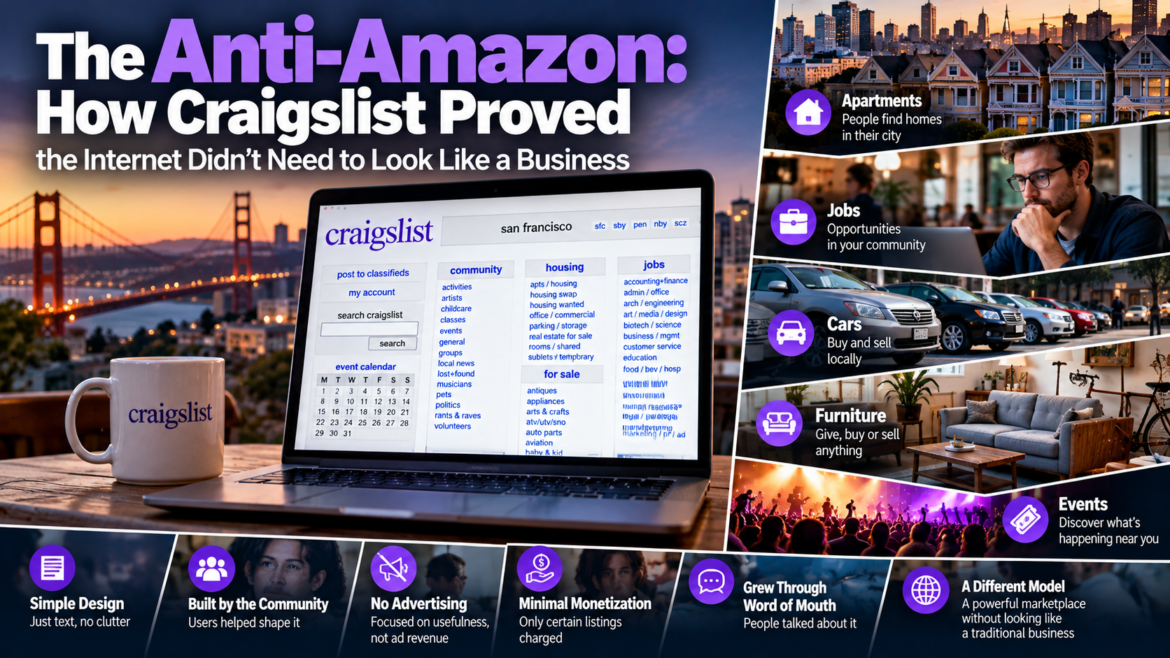
In an internet increasingly obsessed with better design, faster growth and more sophisticated monetization, one of the world’s most influential marketplaces did almost none of those things.
No glossy homepage.
No recommendation engine.
No elaborate product photography.
No banner advertising.
No subscription plan.
No investor-funded growth machine.
Just text.
Jobs. Apartments. Cars. Furniture. Services. Events. People looking for things and people offering them.
And yet Craigslist became one of the defining marketplaces of the early internet.
Its story begins in 1995, when a programmer named Craig Newmark started sending a small email list to friends in San Francisco with information about local arts and technology events. As recipients began contributing their own notices – jobs, apartments, items for sale and more – the list evolved into something larger.
What followed was an unusual internet business.
Craigslist grew largely through word of mouth.
It operated with an extremely small team.
It refused conventional advertising.
And instead of trying to extract maximum revenue from every visitor, it charged only certain categories of posters.
The result was a fascinating lesson in platform economics:
Sometimes the most powerful marketplace is the one that removes itself from the transaction.
The internet was supposed to be commercial
The web of the late 1990s was changing rapidly.
Companies were discovering websites.
Online advertising was emerging.
E-commerce was taking shape.
Investors were pouring money into internet startups.
The dominant question was becoming:
How do we make money from the internet?
Craigslist approached the question differently.
It didn’t begin with a business plan.
It began with a social problem:
People in the same city needed a simple way to exchange information.
Newmark was a programmer working in San Francisco when he started sending emails about interesting local events to friends.
The first list was tiny.
Then people started forwarding it.
Then people started asking for more.
Jobs.
Housing.
Items for sale.
Other local information.
Newmark eventually created a website because the growing email list had become difficult to manage.
The website wasn’t really the original idea.
The community created the demand for it.
Craigslist wasn’t designed as a marketplace
This is one of the most important parts of the story.
Craigslist didn’t begin by saying:
“Let’s build a platform where buyers and sellers transact.”
It evolved from a communication network.
People already had information they wanted to share.
The website simply made that information easier to organize and discover.
That distinction matters.
Many modern platforms begin by designing an economic transaction.
Craigslist began by facilitating connection.
The marketplace emerged from the community.
The name came from the users
Newmark initially considered calling the project “SF Events.”
But users were already referring to the email list as “Craig’s List.”
The name stuck.
Eventually, it became Craigslist.
This small detail reveals something important about the site’s early culture.
The community wasn’t simply consuming a product.
It was helping define what the product was.
Growth came without a marketing budget
Craigslist expanded through word of mouth.
There was no major advertising campaign.
No national television launch.
No elaborate growth strategy.
The service became useful in one city.
People talked about it.
New users joined.
More listings appeared.
More listings attracted more users.
The cycle repeated.
Craigslist’s own historical accounts describe its early growth as largely driven by word of mouth.
This is a classic marketplace dynamic.
Users create inventory.
Inventory attracts users.
Users create more inventory.
The platform becomes increasingly useful as participation increases.
Then Craigslist made a strange design decision
It stayed ugly.
Deliberately.
The homepage was essentially a list of text links.
No elaborate visual branding.
No huge hero image.
No aggressive calls to action.
No endless recommendations.
No sophisticated merchandising.
For a company operating on the internet, this looked almost primitive.
But simplicity was part of the product.
Craigslist itself described its interface as simple and fast because it made the site easy to use.
This is a useful distinction:
Minimalism isn’t always the absence of design.
Sometimes it is design with a very narrow objective.
Craigslist wanted you to find something.
Not admire the website.
The website behaved more like a bulletin board
Craigslist’s design was intentionally reminiscent of something physical:
A community bulletin board.
Someone posts a notice.
Someone else reads it.
They contact each other.
The intermediary largely gets out of the way.
This was radically different from many emerging internet businesses.
Amazon wanted to manage the shopping experience.
eBay wanted to manage the auction.
Craigslist mostly wanted to provide the place where people could find each other.
That created a very different kind of marketplace.
The platform didn’t want to own the transaction
This is perhaps Craigslist’s most important strategic insight.
Consider what happens on a traditional retail platform.
The platform controls:
- Product presentation
- Checkout
- Payment
- Shipping
- Recommendations
- Customer relationship
Craigslist generally doesn’t.
A listing creates an opportunity.
The buyer and seller communicate.
They negotiate.
They decide how to complete the transaction.
The platform steps back.
That reduces complexity.
And it dramatically reduces the cost of operating the marketplace.
Craigslist didn’t need to sell everything
Most internet businesses try to monetize attention.
Craigslist largely refused to.
Its historical press material repeatedly emphasizes that it carried no banner advertising and kept most postings free.
That created an unusual economic model.
Most users pay nothing.
Most listings cost nothing.
There are no conventional display ads.
So where does the money come from?
Certain categories of paid listings.
The business model was remarkably selective
Today, Craigslist charges fees for certain posting categories and locations.
Its current fee schedule includes paid job postings in the United States, certain apartment listings, commercial real estate, dealer vehicle listings, selected gigs and services. Other categories remain free.
This is important.
Craigslist doesn’t try to monetize every participant.
It monetizes specific points of economic value.
A person giving away an old chair may pay nothing.
A company recruiting employees may pay.
Someone selling a used household item may pay little or nothing.
A commercial property advertiser may pay.
The model effectively says:
Keep the marketplace broadly accessible. Charge where the transaction has commercial value.
The classified-advertising industry had a problem
To understand Craigslist’s impact, you have to look at newspapers.
For decades, classified advertising was an important business for newspapers.
A newspaper could sell small advertisements for:
- Jobs
- Cars
- Homes
- Apartments
- Furniture
- Services
- Personal notices
The classifieds were not glamorous.
But they were economically important.
Then the internet arrived.
Suddenly, a digital marketplace could provide something newspapers struggled to match:
Instant updates.
A listing could be posted immediately.
It could remain searchable.
It could be changed.
It could reach a much larger audience.
And in Craigslist’s case, it was often free.
Craigslist attacked the economics of classified ads
This is where the story becomes much larger than one website.
Craigslist didn’t merely compete with newspapers for readers.
It competed for the economic function of classified advertising.
A newspaper had to print the advertisement.
Craigslist only needed to store and display text.
The marginal cost of adding another listing was extremely low.
That allowed Craigslist to offer something traditional media could not easily match:
cheap, persistent, searchable local listings.
The data showed the shift
By 2005, the migration was visible.
Pew Research Center reported that approximately 22% of U.S. internet users had used online classified ads, while classified websites overall had more than 26 million unique visitors in September 2005.
Craigslist sites alone attracted nearly 9 million unique visitors that month, according to comScore data cited by Pew.
The behavior was no longer niche.
People were buying and selling things online.
And classifieds were becoming an important part of that shift.
Craigslist didn’t just sell things
This is where the platform became unusually powerful.
It became a place to find:
Jobs
Apartments
Roommates
Cars
Furniture
Services
Pets
Events
Community discussions
The marketplace reflected the structure of everyday life.
That made Craigslist less like an online store and more like a digital town square.
Locality was the secret weapon
Amazon could sell almost anything.
eBay could connect buyers and sellers across enormous distances.
Craigslist specialized in something different:
local exchange.
Someone in San Francisco could find an apartment in San Francisco.
Someone moving to Boston could find a roommate.
Someone could sell a couch to another person nearby.
Someone could offer a local service.
The physical proximity mattered.
The internet was connecting people globally.
Craigslist used it to reconnect people locally.
That was an important countertrend.
Craigslist understood something about trust
Local marketplaces have a difficult problem.
How do strangers transact?
Craigslist didn’t solve trust with elaborate financial infrastructure.
Instead, it built a culture around relatively direct interaction.
Users could communicate by email.
They could inspect goods.
They could negotiate.
They could meet.
The platform remained relatively neutral.
Craig Newmark repeatedly emphasized the importance of trust and community to Craigslist’s identity.
That trust was not created by technology alone.
It was created by the culture around the technology.
But openness has a dark side
A marketplace that allows people to communicate directly also creates opportunities for abuse.
Scammers.
Spam.
Fraudulent listings.
Harassment.
Unsafe transactions.
Craigslist therefore had to devote significant attention to moderation and abuse prevention.
Newmark personally spent time monitoring listings and dealing with customer-service problems during the site’s early growth.
This reveals an important principle about platforms:
The easier it is for users to create content, the more important governance becomes.
The platform’s openness was its strength.
It was also its vulnerability.
Craigslist chose not to become everything
This is where the company’s strategy becomes particularly interesting.
It could have added:
- Sophisticated payments
- Shipping
- Product recommendations
- Advertising networks
- User accounts
- Subscription programs
- Premium storefronts
Instead, it largely resisted turning itself into a conventional e-commerce platform.
That decision limited some monetization opportunities.
But it also preserved the core experience.
The platform remained remarkably simple.
Simplicity became a competitive moat
This is an unusual kind of moat.
Most technology companies try to build complexity:
More features.
More personalization.
More automation.
More integrations.
Craigslist built familiarity.
The website worked in roughly the same conceptual way users already understood.
Find a category.
Find a listing.
Contact the person.
That predictability became valuable.
You didn’t need to learn the platform.
Craigslist was the anti-feed
Modern social platforms are built around feeds.
You open an application.
The algorithm decides what you see.
Content is ranked.
Recommendations appear.
Attention is optimized.
Craigslist is almost the opposite.
It doesn’t particularly care what you should see.
It gives you a list.
You decide.
That design philosophy is increasingly unusual.
And perhaps that is why the site became so durable.
The marketplace was intentionally boring
This sounds like criticism.
It isn’t.
Boring can be an extraordinary business strategy.
A marketplace doesn’t necessarily need to entertain you.
It needs to reduce the friction between:
Someone who has something
and
someone who wants it.
Every additional feature that doesn’t improve that exchange can become unnecessary complexity.
Craigslist understood this unusually well.
The business had another remarkable characteristic: low costs
Craigslist’s economics were radically different from the venture-funded internet companies of its era.
It didn’t require warehouses.
It didn’t own inventory.
It didn’t need a large sales force.
It didn’t need to deliver physical products.
It didn’t even need a large advertising budget.
Its core infrastructure was essentially:
Servers + software + moderation + customer service
That meant the company could remain relatively small while serving a large audience.
Its own historical accounts described a tiny workforce compared with its audience and noted that it was profitable while operating without conventional advertising.
The eBay episode
Craigslist’s unusual ownership structure became even more interesting in 2004.
eBay acquired a minority stake in Craigslist.
But Craigslist continued to operate independently.
The arrangement attracted attention because eBay was itself one of the world’s largest online marketplaces.
The two companies represented very different philosophies.
eBay built a structured transaction marketplace.
Craigslist remained largely an open classified board.
The contrast was revealing.
There wasn’t just one way to build an internet marketplace.
Craigslist helped create the peer-to-peer economy
The broader impact of Craigslist can be seen in what came later.
Peer-to-peer marketplaces became increasingly common.
People began renting homes.
Selling used goods.
Offering services.
Finding transportation.
Sharing resources.
Connecting directly with one another.
Craigslist wasn’t responsible for all of these businesses.
But it helped demonstrate that the internet could facilitate person-to-person commerce at enormous scale.
The platform didn’t have to own the product.
It didn’t have to employ the seller.
It simply had to make the connection possible.
The smartphone changed the model again
Craigslist emerged in a desktop-web world.
Then smartphones arrived.
Now marketplaces could incorporate:
- Location
- Cameras
- Instant messaging
- Notifications
- Mobile payments
- Identity
- Maps
This created opportunities for a new generation of marketplaces.
OfferUp.
Facebook Marketplace.
Airbnb.
Uber.
DoorDash.
TaskRabbit.
Many of these services added layers Craigslist deliberately avoided.
They made transactions easier.
But they also took a larger role in controlling them.
That is the evolution of the marketplace.
The Craigslist model versus the modern platform
Consider the difference.
Craigslist
Discover → Contact → Negotiate → Transact
Modern managed marketplace
Discover → Verify → Book → Pay → Track → Review
The second model creates a more controlled user experience.
It also creates more opportunities for the platform to monetize.
But it requires much more infrastructure.
Payments.
Identity verification.
Dispute resolution.
Customer support.
Insurance.
Fraud detection.
Logistics.
Reviews.
The platform becomes increasingly involved in the transaction.
Craigslist chose not to go there.
What Craigslist understood about monetization
The most interesting lesson isn’t “don’t monetize.”
It is more subtle:
Monetize the part of the marketplace where willingness to pay is strongest.
If someone wants to sell an old chair, charging them may reduce supply.
If a company desperately needs to recruit employees, it has a stronger willingness to pay.
So Craigslist kept consumer participation largely free while charging commercial participants in selected categories.
That’s a form of cross-subsidization.
Free participation creates liquidity.
Commercial demand creates revenue.
The marketplace survives because the two reinforce each other.
This is a lesson for B2B lead generation too
The principle extends far beyond classifieds.
Suppose a platform has:
Buyers
and
Sellers
Charging both sides equally isn’t necessarily optimal.
One side may be more price-sensitive.
One side may create the inventory.
One side may receive greater economic value.
The platform should understand where the willingness to pay actually sits.
Craigslist’s model demonstrates this elegantly:
Keep participation friction low. Monetize commercial intent.
Craigslist also demonstrated the power of liquidity
A marketplace isn’t valuable because it has listings.
It is valuable because those listings are likely to produce matches.
Imagine a city with:
100 apartments
but no apartment seekers.
Worthless.
Now imagine:
100 apartment seekers
but no listings.
Also worthless.
The marketplace becomes valuable when both sides exist simultaneously.
That’s liquidity.
Craigslist’s local-city structure helped create concentrated pools of supply and demand.
The result was often more useful than a theoretically larger but less locally relevant marketplace.
The empty-city problem
Craigslist expanded city by city.
A new city could initially feel empty.
Few listings.
Few users.
Little activity.
That creates a classic marketplace challenge:
How do you seed a new market?
Craigslist’s expansion relied heavily on organic demand and user requests.
The company added new cities as communities asked for them.
That approach was slow.
But it created an important advantage:
The marketplace was being pulled into new markets by users rather than pushed into them by an advertising campaign.
Craigslist changed the newspaper industry
The most consequential legacy may not be Craigslist itself.
It may be what happened to the businesses that depended on classifieds.
Newspapers historically earned significant revenue from classified advertising.
Digital classifieds offered something cheaper and more immediate.
The migration of classified activity online became part of the broader economic pressure on newspapers.
Pew reported in 2005 that online classified usage was growing rapidly and specifically highlighted Craigslist’s role in that shift.
This is a recurring pattern of digital disruption:
A new technology doesn’t necessarily replace the entire incumbent.
It removes one economically important function.
Then another.
Then another.
The disruption was hidden in plain sight
Craigslist wasn’t trying to destroy newspapers.
It wasn’t even trying to disrupt media.
It was simply helping people find apartments, jobs and used furniture.
That’s an important lesson.
Disruption often happens as a side effect of solving a customer problem better.
The startup doesn’t have to announce:
“We are going to destroy this industry.”
It just has to provide a more convenient alternative.
The business that refused to look like a startup
Silicon Valley developed a recognizable formula:
Raise capital → grow rapidly → acquire users → monetize later → pursue enormous scale
Craigslist followed almost the opposite path.
It grew organically.
It remained private.
It kept costs low.
It avoided conventional advertising.
It monetized selectively.
And it retained an unusually small organization relative to its reach.
Craigslist became one of the great examples of a business that didn’t need to follow the standard startup playbook.
What entrepreneurs can learn from Craigslist
1. Start with usefulness
The original Craigslist wasn’t trying to become a huge company.
It was trying to help a few friends.
Usefulness came first.
2. Don’t monetize before liquidity exists
A marketplace needs participation before monetization can become meaningful.
3. Free can be a strategic weapon
Removing fees can dramatically increase participation.
4. Don’t add features simply because competitors have them
Complexity isn’t automatically progress.
5. Build trust as infrastructure
A marketplace is only as useful as users’ willingness to participate.
6. Monetize economic value, not every interaction
Charge the participants who receive enough value to justify paying.
7. Small organizations can operate large networks
Software can allow a relatively small team to coordinate enormous amounts of activity.
What marketers can learn from Craigslist
There is an especially important lesson here for marketing.
Craigslist did almost no traditional brand advertising.
Its growth mechanism was the product itself.
A user finds something useful.
They tell someone else.
That person joins.
The new user creates or responds to a listing.
That creates more value.
This is product-led growth before the term became fashionable.
The product generated the distribution.
The platform didn’t need to convince people to care
This is one of the strongest lessons for modern digital businesses.
A company can spend enormous amounts of money trying to convince people that a product is useful.
Or it can build something that people naturally recommend because it solves a real problem.
Craigslist’s early growth suggests the latter can be extraordinarily powerful.
Its users weren’t necessarily saying:
“Craigslist has a great brand.”
They were saying:
“Check Craigslist. Someone is selling one.”
That’s a different kind of marketing.
The strange durability of Craigslist
More than three decades after its beginning, Craigslist remains recognizable.
Its interface still looks unusually simple.
Its fundamental categories remain familiar.
Its business model remains selective.
Its core philosophy remains centered on direct connection.
That persistence is itself a lesson.
Technology companies often assume they must constantly reinvent their interface.
Craigslist demonstrates another possibility:
If the underlying problem hasn’t changed, the interface may not need radical reinvention.
The anti-Amazon lesson
Amazon asks:
How can we make commerce increasingly seamless?
Craigslist asks:
How can we help people find each other?
Neither philosophy is inherently superior.
They optimize for different things.
Amazon controls more of the transaction.
Craigslist controls less.
Amazon invests heavily in logistics.
Craigslist largely leaves logistics to participants.
Amazon monetizes transactions extensively.
Craigslist monetizes selected listings.
The contrast demonstrates something important:
A marketplace doesn’t have to own the entire transaction to create value.
And that may be Craigslist’s greatest contribution
The internet is often described as a technology for removing intermediaries.
But most successful platforms eventually become intermediaries themselves.
Craigslist took the idea in a different direction.
It became an intermediary whose goal was, in many cases, to become less visible.
It didn’t need to process every payment.
It didn’t need to deliver every product.
It didn’t need to manage every relationship.
It simply helped two people find each other.
That sounds almost primitive.
But economically, it can be extremely powerful.
From a dozen friends to a new model of commerce
Craigslist began with roughly a dozen people receiving emails about events in San Francisco.
The list grew.
People added their own information.
The website emerged.
More categories appeared.
More cities joined.
A local mailing list became a global marketplace.
The company did not become powerful because it had the most sophisticated technology.
It became powerful because it understood something fundamental about markets:
People already have things other people want.
Jobs.
Homes.
Cars.
Furniture.
Skills.
Services.
Information.
Relationships.
The internet didn’t create those needs.
It simply made the matching process dramatically easier.
The final lesson: Build the market, not necessarily the transaction
This may be the most useful lesson for today’s entrepreneurs.
We often think a platform needs to control everything:
Identity.
Payments.
Delivery.
Customer service.
Recommendations.
Analytics.
But sometimes the most valuable thing a platform can do is simpler:
Bring the right people together.
Once the connection exists, the participants can handle the rest.
Craigslist showed that a marketplace can become enormously valuable without becoming enormously complicated.
It proved that a website doesn’t need to look sophisticated to operate a sophisticated economic system.
And it demonstrated something that remains surprisingly relevant in today’s AI-powered, algorithm-driven internet:
Technology doesn’t always create value by doing more. Sometimes it creates value by getting out of the way.
Craigslist didn’t build the furniture.
It didn’t own the apartment.
It didn’t hire the employee.
It didn’t deliver the sofa.
It simply helped the people who needed each other find each other.
That was enough to change online commerce.