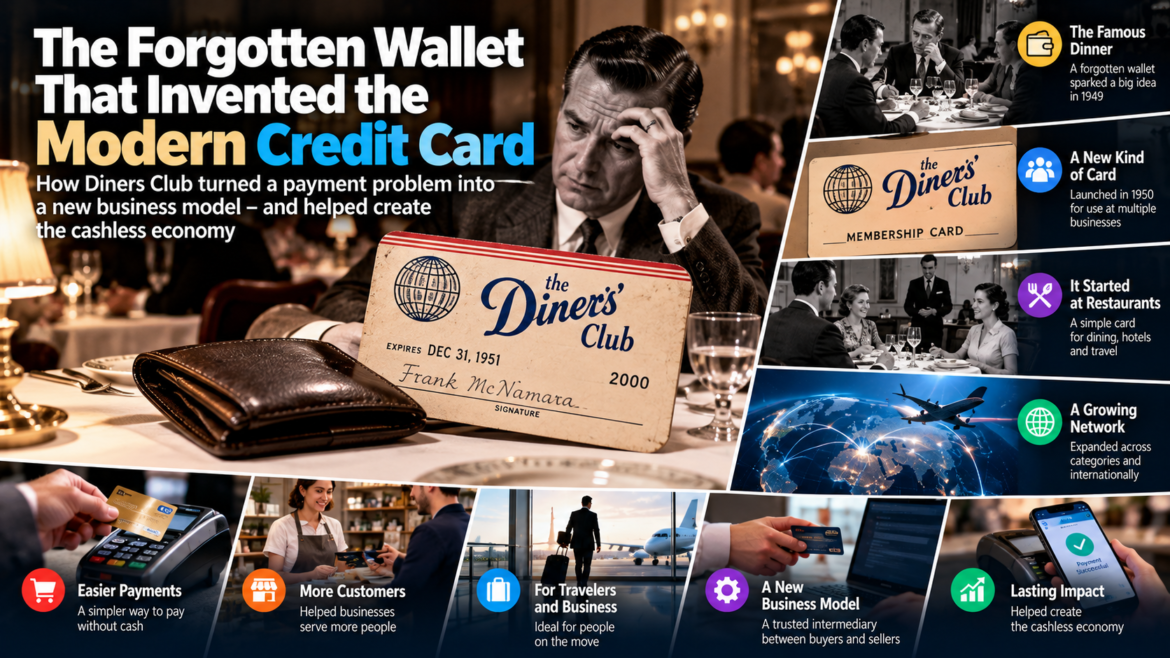
How Diners Club turned a payment problem into a new business model – and helped create the cashless economy
The night a wallet was missing
In 1949, a New York businessman named Frank McNamara sat down for dinner with clients and discovered an awkward problem: he did not have his wallet. The story has become one of the most repeated origin stories in payments, and some details have been debated over the years. The documented part is more important than the legend: McNamara and his partner Ralph Schneider launched Diners Club in 1950, creating a card that could be used at multiple businesses rather than being tied to a single merchant. The Smithsonian describes Diners Club as one of the earliest charge cards and notes how novel it was to pay for a meal simply by presenting the card instead of carrying cash.
The breakthrough was not plastic. It was not even credit in the modern revolving-credit sense. It was the idea that a small, trusted intermediary could sit between many buyers and many sellers and make a transaction feel simpler for both sides.
That sounds ordinary now because the payment card has become invisible infrastructure. In the 1950s, however, it was a new business system.
Before the card, credit was fragmented
Credit existed long before Diners Club. Department stores and other retailers had offered customers store-specific charge accounts, and the Smithsonian traces store payment cards back to innovations such as the Charga-Plate introduced in 1928. The limitation was that these systems generally belonged to individual merchants. A customer could have credit at one store, but that did not create a portable payment identity.
Diners Club changed the unit of convenience. Instead of asking a customer to maintain a separate credit relationship with every participating merchant, it created one membership that could work across a network.
That was a deceptively powerful shift. The product was not really the card. The product was coordination.
The first network effect in everyday payments
Diners Club began in 1950 with a small group of users and participating New York establishments. The company’s own historical account says the first year grew to 10,000 members and 28 participating restaurants and hotels; the Smithsonian records the underlying model as one in which Diners Club billed members and paid restaurants, retaining a processing fee.
The model created a three-sided value proposition. Customers received convenience and the ability to avoid carrying large amounts of cash. Merchants received access to customers who wanted that convenience. Diners Club earned money by operating the bridge between them.
This is a pattern that would later appear across technology businesses: build a system that becomes more valuable as more participants join it, then make the transaction between participants easier than the old alternative.
The business model was the real innovation
Diners Club was a charge-card business rather than the revolving-credit model that would later dominate consumer credit cards. Cardholders were expected to settle their bill, rather than carry an unpaid balance indefinitely. Historical accounts also document an annual membership fee and merchant processing charges. The Smithsonian records a 5-7% processing fee in the early model, while other historical accounts describe fees in a similar range.
That structure matters because it shows how an early payments company monetized convenience before the modern economics of interest-bearing revolving credit had taken over.
In other words, Diners Club did not initially need customers to borrow for years. It could monetize the simple act of making payment easier.
Then the card became a status symbol
Early payment cards were not marketed only as financial tools. They also became markers of identity and membership. The Smithsonian notes that the novelty of paying for an expensive meal with a Diners Club card made membership a status symbol. That was a subtle but important piece of product design: the company was selling belonging as well as convenience.
The target customer also mattered. Diners Club initially focused heavily on businesspeople and travelers – people for whom restaurants, hotels and expenses were frequent and where carrying cash created friction.
This is a classic early-stage strategy: do not begin by trying to solve everyone’s problem. Find the users for whom the problem is frequent, expensive or embarrassing enough that they will adopt a new behavior.
The idea escaped the restaurant
Once customers had a reason to carry the card, the potential network could expand. Diners Club moved beyond restaurants into hotels and other categories, while international acceptance followed. The company says it became the first internationally accepted charge card in 1953.
This was the moment the concept became bigger than the original problem. The problem was no longer ‘What do I do if I forget my wallet?’ It became ‘Why should payment depend on the particular merchant I happen to be visiting?’
That question points toward the modern payment network: a standardized way to establish trust across unfamiliar transactions.
Competition proved the idea was bigger than one company
Diners Club did not create the entire modern credit-card industry by itself. Other experiments preceded it, and competitors quickly followed. The Smithsonian notes that Diners Club helped popularize card payments during the 1950s and that its success prompted other companies to issue similar cards. By the late 1950s, general-purpose cards such as BankAmericard and American Express were entering the market.
The next major breakthrough was different: revolving credit. BankAmericard, introduced in 1958, allowed customers to carry balances and pay over time, helping establish the model that would eventually become central to consumer credit cards.
This distinction is important. Diners Club helped prove that a multi-merchant payment card could work as a business. Later players expanded the economic model and the scale.
From a piece of cardboard to invisible infrastructure
The early Diners Club card was not the sleek plastic rectangle people associate with credit cards today. Smithsonian collections include paper Diners Club cards from the 1950s, illustrating just how physical and manual the original system was.
Yet the physical card was only the visible interface. Behind it was a new coordination layer: membership records, merchant acceptance, billing, settlement and trust.
That is why the deeper legacy of the card is not the object itself. It is the separation of payment from physical cash.
Once that separation became normal, subsequent innovations could keep moving payment further away from the act of handing over money: magnetic stripes, electronic authorization, online payments, mobile wallets and contactless transactions.
The lesson for today’s technology companies
The Diners Club story offers a useful lesson for founders and marketers: the breakthrough product is often not the technology customers see.
The card was easy to understand. The difficult innovation was designing a system in which merchants would accept it, customers would want it, and the company could profit from connecting them.
That is the same strategic challenge faced by today’s marketplaces, payment platforms, app ecosystems and digital networks. A product can be technically impressive and still fail if the surrounding network does not work. Conversely, a simple interface can become transformative when it coordinates a complicated system behind the scenes.
Another lesson is that friction can be a better starting point than invention. McNamara did not begin with a grand theory of financial infrastructure. The famous origin story begins with an everyday inconvenience. The insight was to recognize that the inconvenience represented a much larger pattern.
What Diners Club ultimately changed
Diners Club did not invent the concept of credit, and it was not the first attempt to let consumers buy without immediate cash. Its significance was more specific: it demonstrated that a payment credential could travel with the customer and work across a network of independent merchants. The Smithsonian explicitly credits the company with helping transform payment methods, while Diners Club’s own history records a succession of later industry firsts, including corporate cards and rewards.
The modern card industry eventually became vastly larger and technologically different. But the basic promise remains recognizable: carry a credential, present it at a merchant, and let an invisible system handle the trust and settlement behind the transaction.
That is the lasting innovation. Diners Club helped turn payment from a physical act into a network service.
Conclusion: The best innovations often remove themselves
The most powerful technologies eventually become ordinary. Nobody pauses to admire a payment network when tapping a phone at a checkout counter. Nobody thinks about settlement systems when a card transaction is approved in seconds.
That invisibility is a sign of success.
Diners Club began with a simple problem – how to pay when cash was inconvenient – and helped establish a new expectation: payment should follow the customer, not the merchant.
More than seven decades later, the lesson remains relevant. Great innovation is not always about adding capability. Sometimes it is about removing a small piece of friction so completely that an entirely new behavior becomes normal.