
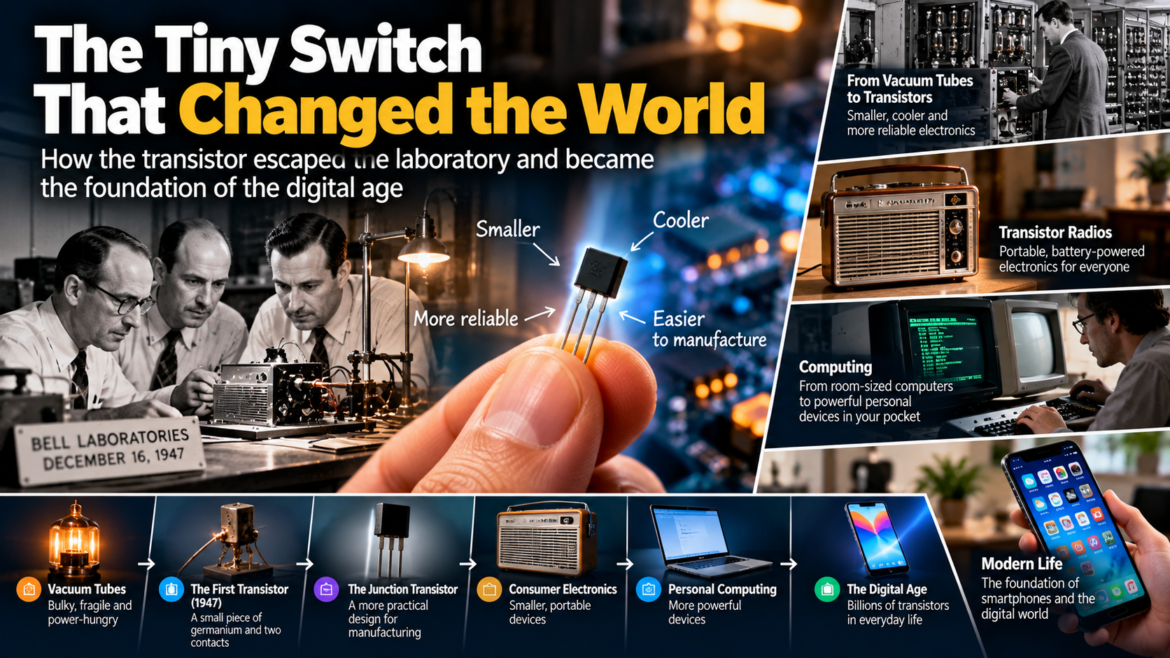
How the transistor escaped the laboratory and became the foundation of the digital age
The machine that was too big to keep growing
In the middle of the 20th century, the future of electronics had a size problem. Vacuum tubes had made radio, radar, long-distance telephony and early electronic computing possible, but they were bulky, fragile and power-hungry. They generated heat, consumed significant power and eventually failed. The few computers built with them could occupy entire rooms.
The obvious question was not yet how to build a smartphone or a laptop. It was much more basic: could electronics be made smaller, cooler, more reliable and easier to manufacture?
In December 1947, three researchers at Bell Telephone Laboratories – John Bardeen, Walter Brattain and William Shockley – helped answer that question with a device that initially looked almost absurdly unimpressive: a small piece of germanium, a plastic support and two tiny gold contacts.
It was the transistor. And although it was only the beginning of a much longer chain of inventions, the transistor became the fundamental switching and amplification device behind modern electronics. IEEE describes it as the basic building block of the electronics industry and notes that its descendants enabled the miniaturization of systems from room-sized computers to processors containing billions of devices.
The problem Bell Labs was really trying to solve
Bell Labs did not set out simply to invent a smaller gadget. Its researchers were working on a strategic problem created by the telephone network itself.
Long-distance telephone systems needed signals to be amplified. Vacuum-tube amplifiers could do the job, but the tubes were unreliable and expensive to maintain at scale. Bell Labs therefore invested in semiconductor research in the hope of finding a solid-state alternative.
The important insight was that certain materials, called semiconductors, could be manipulated so that electrical current behaved in controllable ways. The challenge was turning that physics into a practical device.
That distinction matters. The transistor was not a single flash of inspiration detached from everything before it. Earlier researchers had proposed transistor-like concepts, and semiconductor physics had been developing for decades. What Bell Labs achieved was the difficult transition from theoretical possibility to a functioning, repeatable device. IEEE’s historical account describes the invention as the culmination of a long search for a solid-state replacement for the vacuum tube.
December 16, 1947
The breakthrough came in the laboratory of Bardeen and Brattain.
Their first successful device was a point-contact transistor. Two closely spaced gold contacts touched a small piece of germanium, allowing the researchers to control and amplify an electrical signal. On December 16, Brattain and Bardeen achieved a configuration that produced reliable power gain. A week later, on December 23, they demonstrated the device to Bell Labs executives.
IEEE Spectrum’s detailed history records Brattain later describing the December 16 experiment as the most important experiment of his life. The device was crude, fragile and difficult to manufacture, but it worked.
That is often how technological revolutions begin: not with a finished product, but with proof that something previously considered impractical can work.
Why the first transistor was not the transistor we know
The first transistor was a remarkable scientific achievement, but it was not yet a mass-market component.
Point-contact transistors were delicate. Manufacturing consistency was difficult, and the design was not ideal for large-scale production. William Shockley, who led the semiconductor research group, subsequently developed the bipolar junction transistor, a more robust design based on layers of semiconductor material.
The junction transistor was eventually easier to manufacture and became the dominant transistor technology for many applications. IEEE Spectrum notes that Shockley conceived the junction transistor in early 1948 and that it eventually superseded the point-contact device.
This is an important part of the story because invention and commercialization are not the same thing. The first working prototype proved the principle. The next generation had to make the principle useful.
The invention became an industry
Bell Labs licensed its transistor technology rather than keeping the invention exclusively for itself. Companies began producing transistorized components for practical applications.
Early uses included hearing aids, oscillators, telephone equipment and experimental computing systems. Point-contact transistors were even used in the TRADIC airborne computer, an important early digital system.
The transistor also changed consumer electronics. Portable transistor radios demonstrated something vacuum-tube electronics struggled to provide economically: small, battery-powered electronic products that people could carry with them.
The significance was larger than any one product category. Once electronics could become smaller and consume less power, designers could put electronic intelligence into places where tubes were simply impractical.
Silicon changes the economics
Germanium helped launch the transistor age, but silicon would become the material around which modern semiconductor manufacturing was built.
In the 1950s, engineers at companies including Bell Labs and Texas Instruments worked on silicon transistors. IEEE Spectrum’s history of this transition describes Gordon Teal’s work at Texas Instruments and the emergence of commercial silicon transistors as a major step toward scalable semiconductor technology.
Silicon offered characteristics that made it particularly valuable for electronics, and improvements in materials, manufacturing and device design steadily pushed transistors toward greater reliability and lower cost.
The revolution was therefore not simply ‘the transistor.’ It was an ecosystem of materials science, manufacturing techniques, circuit design and industrial learning that made the transistor economically useful.
The bridge to the integrated circuit
The next giant leap was to stop treating transistors as separate components.
If individual transistors could be manufactured reliably, engineers could ask a much more consequential question: what if many electronic components could be built together on the same piece of semiconductor?
That idea led to the integrated circuit, developed independently in the late 1950s by Jack Kilby at Texas Instruments and Robert Noyce at Fairchild Semiconductor. The transistor was the essential building block that made this next step possible.
From there, semiconductor technology began a compounding journey: more components on each chip, smaller dimensions, better performance, lower cost and dramatically greater computing capability.
IEEE describes the transistor as the foundation for the later integration of billions of devices onto a single silicon chip through CMOS technology.
From a laboratory component to billions of switches
The transistor’s greatest achievement is not that the original device was small. It is that the device could keep getting smaller.
That property changed the economics of computing. A computer no longer had to be a room full of expensive machinery. Electronic functions could increasingly be compressed into smaller systems and eventually into chips.
The chain of consequences is familiar today but extraordinary when viewed historically: mainframes, minicomputers, calculators, digital watches, personal computers, mobile phones, GPS receivers, medical devices, networking equipment and modern data centers all depend on semiconductor switching.
IEEE notes that the transistor enabled breakthroughs across computing, communications, transportation and medicine.
The smartphone therefore did not begin with the smartphone. It began with the ability to control electricity inside a tiny solid-state device.
The business model lesson hidden inside the transistor
There is also a business lesson in this history.
Bell Labs was part of AT&T’s vertically integrated telecommunications system. Its research environment allowed scientists to work on problems whose commercial payoff might not be immediate. The transistor was born from a specific operational need – making the telephone network more reliable – but its usefulness quickly extended far beyond telecommunications.
That is a powerful innovation pattern: solve a difficult infrastructure problem deeply enough, and the resulting technology can become a platform for markets that did not exist when the research began.
The transistor created value in layers. First came components. Then radios and specialized equipment. Then integrated circuits. Then computers. Then consumer electronics. Then mobile and internet infrastructure. Each generation built on the previous one.
The original invention therefore became far more valuable than its first application suggested.
Why this story matters in the age of AI
It is tempting to describe today’s AI revolution as if it began with software models. But beneath the software sits another, much older revolution.
Every large AI system ultimately depends on semiconductor hardware: processors, memory, networking equipment and data-center infrastructure. The ability to manufacture enormous numbers of reliable, microscopic switching devices is what makes modern computation possible at scale.
That does not mean the transistor itself is the only reason AI exists. Modern computing required many additional breakthroughs in integrated circuits, architecture, software, networking, algorithms and manufacturing. But the transistor established the physical foundation on which that stack could grow.
The lesson for today’s technology leaders is straightforward: some of the most consequential innovations are enabling technologies. They may not look like the final product consumers care about, but they can change what entire generations of products are capable of becoming.
The overlooked lesson: invention is only the beginning
The transistor story is sometimes reduced to a single date – 1947 – and three names. The reality is more instructive.
The first device was imperfect. Its inventors did not have a complete roadmap for the industries it would eventually create. Other engineers had to improve the design. Manufacturers had to solve production problems. Materials scientists had to improve semiconductor quality. Circuit designers had to learn how to exploit the technology. Entrepreneurs had to build businesses around it.
IEEE’s historical review emphasizes that it took roughly another decade of technical hurdles and breakthroughs before high-performance, high-reliability transistors could be manufactured in large quantities at low cost.
That is the difference between invention and technological transformation.
An invention proves something is possible. An innovation becomes transformative when an ecosystem learns how to make it reliable, affordable, scalable and useful.
Conclusion: The smallest idea can carry the biggest future
The first transistor did not look like the future.
It was a fragile laboratory device made from germanium and gold contacts. It could not run a smartphone, power a cloud data center or train an AI model. It did not resemble any of the products that would eventually depend on it.
But it solved a fundamental problem: how to control and amplify electrical signals without relying on bulky vacuum tubes.
From that narrow breakthrough grew an industry that steadily compressed computation, communication and control into smaller and smaller spaces.
The transistor’s greatest lesson is therefore not simply that small things can be powerful. It is that foundational technologies can have lives far beyond their original purpose.
The device Bell Labs built in 1947 was a solution to a telecommunications problem. What it became was something much bigger: one of the physical foundations of the digital world.