
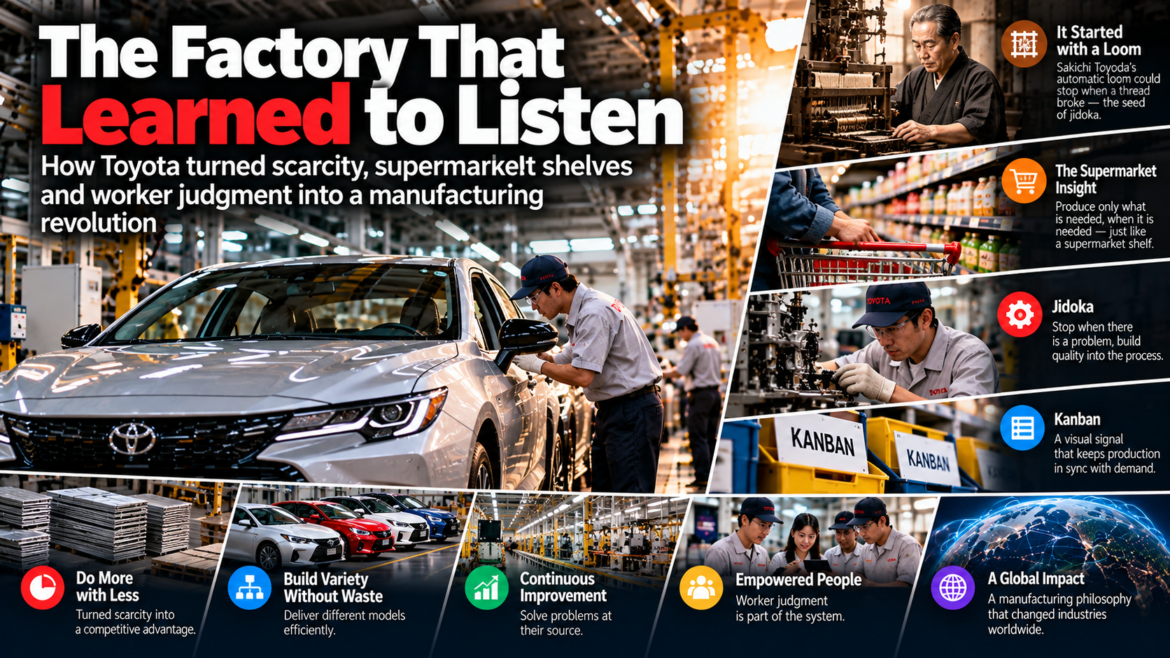
How Toyota turned scarcity, supermarket shelves and worker judgment into a manufacturing revolution
A factory built for a world that did not exist
After the Second World War, Toyota faced a problem that looked almost impossible. The Japanese automaker was competing with American manufacturers whose factories were designed around enormous production volumes. Toyota did not have the same market, capital or resources. It could not simply copy Detroit and hope to win.
Its answer was not a faster version of mass production. It was a different question: what if a factory produced only what customers actually needed, when they needed it, while treating every defect and delay as a problem to be understood?
Over decades, Toyota developed a system that would become known as the Toyota Production System, or TPS. Its two foundational ideas were just-in-time and jidoka – producing what is needed when it is needed, and building quality into the process by stopping when abnormalities occur. Toyota describes the system as a way to eliminate waste, shorten lead times and deliver vehicles with good quality at a competitive price.
What began as a survival strategy eventually became one of the most influential business systems of the modern era.
The problem was not efficiency. It was mismatch.
American mass production had demonstrated the extraordinary power of scale. Large factories could produce huge quantities of standardized products efficiently. But Toyota was operating in a very different environment: limited capital, limited materials and a Japanese market that could not absorb endless quantities of one model.
The company needed variety without drowning in inventory. It needed high quality without building giant inspection departments. It needed productivity without assuming that every customer wanted the same thing.
That constraint became an advantage because it forced Toyota engineers to challenge assumptions that mass production had made seem natural.
The goal was not simply to make workers move faster. It was to make the entire flow of work more intelligent.
Before the factory, there was a loom
One of the deepest ideas in TPS began before Toyota built cars.
Sakichi Toyoda, founder of the Toyota Group, developed automatic looms. Toyota’s own history says his motivation was partly personal: he wanted to make his mother’s difficult weaving work easier. His automatic loom could stop when a thread broke, preventing the machine from continuing to produce defective fabric.
This became the foundation of jidoka – often translated as autonomation or automation with a human touch.
The important idea was not that machines should replace people. It was that a machine should recognize an abnormal condition and stop rather than quietly producing more bad output.
That principle later moved from the loom to the automobile factory. If a problem occurred, the process could stop, the abnormality could become visible, and people could investigate its cause.
In conventional thinking, stopping a production line sounds like failure. In Toyota thinking, allowing a known defect to travel downstream is the bigger failure.
The supermarket insight
Toyota’s second pillar emerged from a different observation.
Kiichiro Toyoda, who established Toyota’s automobile business, developed the idea of just-in-time in the 1930s. Toyota’s later production system refined it dramatically after the war. According to Toyota’s account, the postwar system drew inspiration from supermarkets: downstream processes would effectively take what they needed from upstream processes, triggering replenishment based on actual consumption.
This is the logic behind kanban, the visual signaling system associated with Toyota.
Imagine a supermarket shelf. The store does not keep every item it has ever sold sitting beside the checkout. Customers take products. The empty space becomes a signal to replenish.
Toyota applied the same logic to production: make or move what has been consumed, rather than automatically pushing large quantities forward simply because the previous process has capacity.
That shift changed the direction of information. Instead of production constantly pushing work downstream, demand could pull work through the system.
Taiichi Ohno turns separate ideas into a system
The ideas of jidoka and just-in-time had earlier roots, but Taiichi Ohno is widely credited with developing them into the Toyota Production System during the 1950s and 1960s. The Lean Enterprise Institute describes Ohno’s work as beginning in machining and spreading across Toyota’s operations, with the system later extending into the supplier network.
Ohno’s challenge was especially difficult because Toyota wanted variety at comparatively low volumes. The objective was not merely to eliminate visible waste. It was to create a system in which problems could be exposed quickly and solved at their source.
That required standardized work, visual controls, small inventories, flexible processes and a culture of continuous improvement.
The result was a factory that behaved less like a giant machine and more like a learning system.
Waste became something you could see
One of the most influential parts of Toyota thinking is the concept of muda, or waste.
Waste was not limited to obvious scrap. Waiting, excess inventory, unnecessary movement, overproduction, rework and inefficient processes could all consume resources without creating value for the customer.
Toyota’s objective was therefore not simply ‘reduce costs.’ It was to expose the causes of wasted time, material, movement and effort.
This distinction is important. Cutting a cost can produce a one-time saving. Removing the cause of waste can change the process itself.
Toyota’s official description emphasizes the complete elimination of waste and shortening lead time, while the Lean Enterprise Institute describes TPS as a system built around just-in-time, jidoka, standardized work and kaizen.
The strange power of stopping the line
Perhaps the most counterintuitive Toyota practice is also one of the most important: stop when there is a problem.
A traditional production environment can create an incentive to keep the line moving. Stopping production looks expensive. But if a defect is allowed to continue, the cost can multiply as the problem moves through subsequent processes.
Jidoka reverses that logic. Make the abnormality visible early. Stop. Investigate. Fix the cause. Then resume.
Toyota’s virtual plant tour describes systems in which equipment stops when abnormalities are detected and workers are alerted to problems, while poka-yoke mechanisms help prevent simple errors from becoming defects.
The deeper lesson is organizational: a system cannot improve what it hides.
That is why Toyota’s production system was not only an inventory system or a collection of factory techniques. It was a method for turning problems into information.
Why continuous improvement became a competitive weapon
Kaizen is often translated as continuous improvement, but its significance is deeper than the phrase suggests.
The system assumes that today’s process is not the final process. Workers and managers are expected to understand the current condition, identify abnormalities and improve the work through repeated experiments.
Jim Womack, whose MIT research helped introduce lean production to a global management audience, wrote that what struck him about Toyota was its precision: standard work, visible conditions, clear inventory levels and rapid identification of problems created a foundation for improvement.
This creates a compounding advantage. One improvement may save seconds. Thousands of improvements, repeated for years, can change the economics of an entire operation.
The world discovers the system
For decades, Toyota’s methods remained largely a story inside Japanese manufacturing. Then researchers from MIT’s International Motor Vehicle Program studied the global auto industry.
Their work culminated in the 1990 book The Machine That Changed the World by James Womack, Daniel Jones and Daniel Roos. The research popularized the term ‘lean production’ for the system they observed and helped turn Toyota’s manufacturing practices into a global management idea.
The MIT study found major differences between traditional mass production and the lean system in productivity, quality, inventory and development performance. Lean Enterprise Institute summarizes the research as showing substantially lower resource requirements while supporting greater variety and fewer defects.
The factory had become a management philosophy.
The surprising business model behind lean
It is tempting to describe Toyota Production System as a cost-cutting machine. That interpretation misses its commercial logic.
Toyota’s system was designed around customer demand, quality, lead time and the elimination of waste. Lower cost was a consequence of a better system, not simply the objective of making every department spend less.
This distinction became especially important as lean methods spread beyond manufacturing. In hospitals, software teams, logistics operations and service businesses, managers began asking the same questions: What does the customer actually value? Where does work wait? Where does information get lost? Which steps create no value? How quickly can a problem be identified?
MIT Sloan has specifically warned against reducing lean management to layoffs, downsizing or simple cost cutting, describing it instead as a way of thinking about how work is performed throughout an organization.
NUMMI proved the ideas could travel
One of the most revealing chapters came in California.
In 1984, Toyota and General Motors created the New United Motor Manufacturing Inc. joint venture, known as NUMMI. The plant gave Toyota a chance to apply its production system in an American setting, while GM gained direct exposure to Toyota’s operating methods.
The experiment became an important demonstration that the system was not simply a product of Japanese culture. The Lean Enterprise Institute notes that NUMMI marked the beginning of TPS dissemination outside Japan in earnest. The joint venture eventually produced about eight million vehicles over 25 years before closing in 2010.
The broader lesson was significant: systems of work can travel when the underlying principles are understood rather than copied mechanically.
The mistake companies make when they copy Toyota
The popularity of lean created a paradox. Once the world learned Toyota’s vocabulary, companies began copying its visible tools.
Kanban boards appeared. Five-S programs appeared. Process maps appeared. Posters about waste appeared.
But a tool is not a management system.
The deeper Toyota approach connects standard work, problem solving, employee involvement, visual management, flow, pull, quality at the source and continuous learning. Remove those connections and a company can end up with the appearance of lean without its operating logic.
The Lean Enterprise Institute has repeatedly emphasized that lean is a complete business system rather than a toolbox of isolated techniques.
Why this matters far beyond factories
The most interesting part of Toyota’s legacy is what happened after the factory.
The principles were adapted to software development, healthcare, logistics, retail, product development and service operations. The vocabulary changed, but the central questions remained familiar.
What is the customer waiting for? What is creating value? Where is work piling up? How do we detect errors earlier? How can the people doing the work improve the process?
For a modern business, those questions can be applied to a sales pipeline just as easily as an assembly line.
A lead waiting three days for qualification is inventory. A campaign repeatedly rejected for the same data-quality reason is rework. A prospect passed between teams without clear ownership is motion without value. A dashboard that hides the real bottleneck is the organizational equivalent of a machine that keeps running while producing defects.
This is an interpretation rather than a historical claim, but it reveals why Toyota’s ideas remain useful: they describe the behavior of systems, not just factories.
The lesson for the age of AI
Artificial intelligence is making it possible to automate tasks at extraordinary speed. That makes Toyota’s lessons more relevant, not less.
If an inefficient process is automated, the organization may simply produce bad output faster.
Toyota’s system starts elsewhere: make the process visible, define the standard, expose abnormalities, solve root causes and continuously improve.
In an AI-enabled company, that could mean monitoring where human review is still required, identifying recurring errors in generated content, measuring response quality rather than raw automation volume, and designing feedback loops that allow systems to improve.
The strategic lesson is simple: automation is not the same as improvement. Improvement comes from understanding the system.
Conclusion: Toyota did not build a faster factory. It built a learning machine.
The revolutionary idea behind Toyota Production System was not a clever inventory trick or a Japanese version of Ford’s assembly line.
It was a different way of thinking about work.
Make only what is needed. Let demand pull production. Stop when something goes wrong. Put quality into the process. Make problems visible. Give people the ability to improve the work. Repeat.
Those principles emerged from scarcity, experimentation and decades of disciplined refinement. They eventually became a global management language.
Toyota’s greatest innovation was therefore not simply manufacturing more efficiently. It was creating a system in which the factory could learn. And that may be the most valuable lesson for modern businesses: the strongest organization is not necessarily the one that never encounters problems. It is the one that discovers problems early, learns from them quickly and makes the next version of the system better.