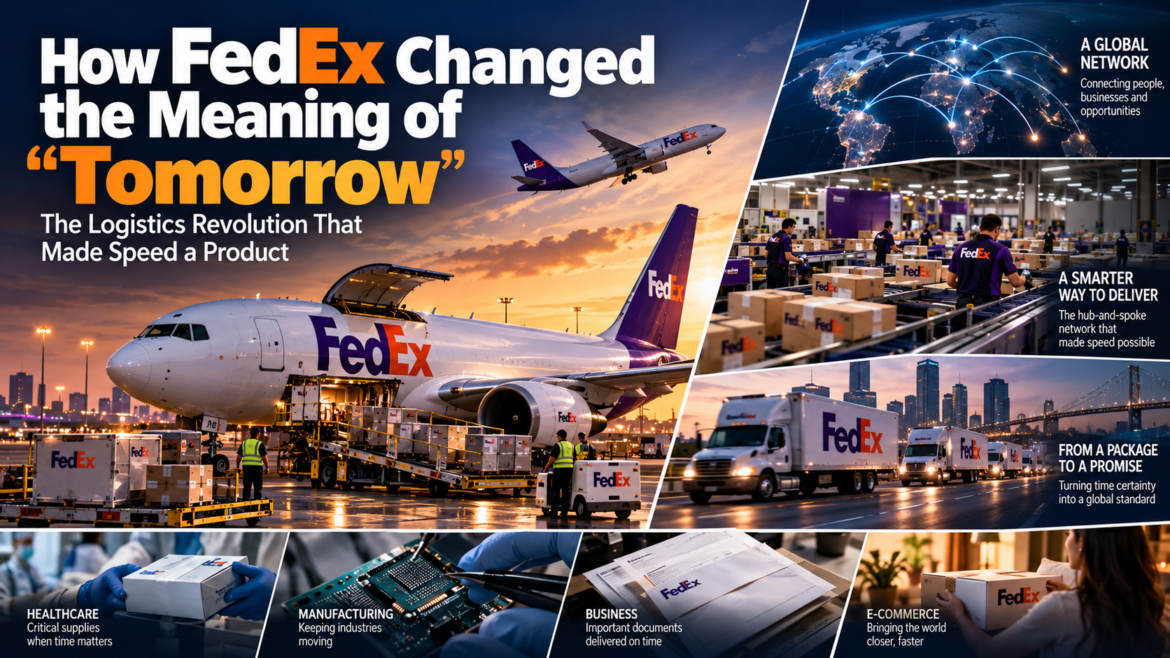
Before FedEx, shipping was largely about moving things from one place to another. Federal Express turned something else into a product: certainty about when the package would arrive.
In 1965, a Yale student named Frederick W. Smith wrote a term paper proposing a new way to move time-sensitive shipments.
The problem was straightforward.
A business might need to move something urgently – medicine, computer components, electronics or important documents – but the existing transportation system was designed largely around moving freight efficiently, not guaranteeing extremely fast, time-critical delivery.
Smith’s idea was different.
What if an entire transportation network were designed around speed and time certainty?
The idea eventually became Federal Express.
And on April 17, 1973, the company began operations in Memphis with just 14 aircraft, 389 employees and 186 packages destined for 25 U.S. cities.
It sounds almost insignificant compared with today’s logistics networks.
But those 186 packages represented the beginning of a new industry.
FedEx didn’t simply create a faster delivery company.
It helped establish a new expectation:
If something is important enough, it can be delivered overnight.
That expectation would eventually reshape business, e-commerce, manufacturing, healthcare and consumer behavior.
The problem wasn’t transportation. It was time.
Transportation has existed for thousands of years.
Trucks moved goods.
Ships crossed oceans.
Railways connected cities.
Airplanes dramatically reduced travel time.
But businesses faced a specific problem:
What happens when the value of a shipment depends on arriving quickly?
A computer manufacturer might need a replacement component.
A hospital might need medical equipment.
A financial institution might need documents.
A business might need a contract delivered before a deadline.
In those situations, transportation speed isn’t merely a convenience.
Time becomes part of the value of the product.
Smith’s insight was that there should be a transportation network designed specifically around those shipments.
FedEx’s own history describes the original idea as a system for handling time-sensitive shipments such as medicine, computer parts and electronics.
That distinction became the foundation of the company.
The Yale paper that started the idea
According to FedEx’s corporate history, Smith wrote his term paper at Yale in 1965 describing a system designed to accommodate time-sensitive shipments.
The paper reportedly received an average grade.
Whether the famous story about the grade is representative of the complete academic context is less important than what happened afterward.
Smith didn’t abandon the idea.
He continued developing it.
In 1971, he founded Federal Express Corporation.
Two years later, the system went live.
The transition from university paper to operating logistics network required far more than an interesting concept.
It required aircraft.
Facilities.
Routing.
Drivers.
Sorting systems.
Information technology.
Regulatory approvals.
Capital.
And, most importantly, a network architecture capable of coordinating all of them.
That architecture became one of the company’s most important innovations.
Why Memphis?
At first glance, Memphis might seem like an unusual choice for the center of an air-delivery network.
But the location had several characteristics FedEx considered valuable.
The company’s historical account highlights:
- Its central location within the United States
- An airport that was relatively rarely closed because of bad weather
- Airport support for improvements required by the operation
- Availability of additional hangar space
The choice reflected a critical principle:
A logistics network is only as good as the infrastructure underneath it.
FedEx wasn’t simply choosing a city.
It was choosing the central node of a system.
The hub-and-spoke breakthrough
One of the most important ideas behind FedEx was its hub-and-spoke network.
Instead of trying to operate direct routes between every possible pair of cities, packages could be brought into a central hub, sorted and then sent outward toward their destinations.
Imagine a network connecting 25 cities.
A completely direct system could require a huge number of routes.
A hub system concentrates movement.
Packages travel:
Origin → Hub → Destination
That sounds less direct.
But for a highly coordinated network, it can actually be much more efficient.
The hub becomes the point where the entire system is synchronized.
FedEx identifies its hub-and-spoke approach as one of the foundational innovations behind its network.
This is where the company moved beyond simply being a courier.
It became a network design company.
The first night
On April 17, 1973, Federal Express began operations from Memphis.
The numbers were tiny by modern standards:
389 employees
14 aircraft
186 packages
25 U.S. cities
But the system worked.
The company’s first overnight operation delivered those 186 packages across the network.
This was the birth of what FedEx describes as the modern air/ground express industry.
The important innovation wasn’t that an airplane moved packages overnight.
Airplanes had been moving cargo for decades.
The innovation was building the entire system around a guaranteed time-sensitive service.
FedEx wasn’t really selling transportation
This is the deeper business idea.
A customer doesn’t particularly care how a package travels.
They care about the outcome.
They want to know:
Will it arrive tomorrow?
That means FedEx wasn’t really selling:
“Aircraft capacity.”
It was selling:
“Certainty.”
That distinction is enormously important in business.
A logistics company can sell transportation.
A premium logistics company can sell time.
And when time has economic value, customers can pay more for it.
The package became a promise
Think about what happens when you send an overnight package.
You’re not simply handing over an object.
You’re making a request:
“Make sure this object is somewhere else by a particular time.”
The logistics company therefore takes on a form of responsibility.
The product becomes:
Pickup + transportation + sorting + tracking + delivery + time commitment
That is a very different product from simply moving freight.
FedEx built its brand around that promise.
Information became as important as aircraft
There is another part of the FedEx story that is easy to overlook.
You can’t operate a massive time-sensitive network simply by moving physical objects.
You have to know:
- Where each package is
- Where it needs to go
- Which aircraft it belongs on
- Which truck will deliver it
- Whether it missed a connection
- Whether it has reached its destination
That makes logistics an information problem as much as a transportation problem.
FedEx explicitly identifies the integration of information technology with its hub-and-spoke network as a foundational part of the company’s development.
This idea would become increasingly important as the company scaled.
Then the network got bigger
The original Falcon jets were not going to be enough forever.
In 1977, Federal Express purchased seven Boeing 727 aircraft.
Each had a cargo capacity of about 40,000 pounds, nearly seven times that of the Dassault Falcon aircraft used during the company’s early operations.
This wasn’t simply a fleet upgrade.
More capacity meant the network could move more packages.
More packages made the network more economically viable.
Greater network density improved the value of the service.
And more customers generated more volume.
This is another characteristic of network businesses:
Scale can improve the economics of the system itself.
The SuperHub
In 1981, Federal Express opened its SuperHub beside Memphis International Airport.
The hub became the physical heart of the operation.
Imagine thousands of packages arriving in a narrow time window.
They need to be:
unloaded → identified → sorted → routed → loaded → dispatched
The entire process is essentially a giant physical algorithm.
Every package is an input.
The hub processes it.
The next aircraft or vehicle is the output.
This is why modern logistics increasingly resembles computing.
The objects are physical.
The decision-making is informational.
The logistics network became a machine
A useful way to think about FedEx is as a machine with several layers.
Layer 1 – Collection
Packages enter the network.
Layer 2 – Identification
The system determines what each package is and where it needs to go.
Layer 3 – Routing
The package is assigned to the appropriate path.
Layer 4 – Hub processing
Packages are consolidated and sorted.
Layer 5 – Transportation
Aircraft and vehicles move them through the network.
Layer 6 – Last-mile delivery
The package reaches the customer.
The genius is not any individual component.
It is the coordination of all of them.
The business model was built around premium time
FedEx created a service where customers paid for something traditional shipping didn’t necessarily prioritize to the same degree:
speed and predictability.
That created a premium category.
Instead of competing purely on:
“Who can transport this cheapest?”
the company could compete on:
“Who can transport this reliably within a defined time window?”
That distinction opened a different market.
Customers with urgent shipments could rationally pay more because the cost of delay could be much higher than the cost of shipping.
This changed how businesses operated
Once overnight delivery became reliable enough, businesses could reorganize their own operations.
Manufacturers didn’t necessarily need to hold every replacement component locally.
Businesses could move documents rapidly.
Companies could coordinate across greater distances.
Suppliers could respond more quickly.
Inventory strategies could evolve.
Geographic distance became slightly less restrictive.
Fast logistics became an operational capability.
That is when a transportation company starts affecting industries far beyond transportation.
Then tracking changed the customer relationship
At some point, customers stopped being satisfied with:
“We have shipped your package.”
They wanted to know:
“Where is my package right now?”
Package tracking transformed logistics from a black box into an observable process.
The customer could increasingly see events in the journey.
Picked up.
Arrived at facility.
Departed facility.
Arrived at destination city.
Out for delivery.
Delivered.
That visibility changed expectations.
A shipment wasn’t just something you handed over to a carrier.
It became something you could monitor.
The tracking number became a product feature
This is a subtle but important innovation.
The tracking number appears to be a small operational detail.
It isn’t.
It gives customers a digital identity for a physical object.
A package becomes a record.
The record generates events.
The events become visible.
The physical shipment therefore acquires a digital layer.
This idea would later become fundamental to e-commerce.
FedEx helped prepare the world for e-commerce
Modern online shopping depends on an assumption that would have seemed extraordinary decades ago:
You can order something you cannot physically see, and it will arrive at your door.
That requires trust.
The customer needs to believe:
- The seller will ship the item.
- The carrier will transport it.
- The package can be tracked.
- It will arrive within a reasonable timeframe.
- Problems can be resolved.
E-commerce didn’t create logistics.
But it dramatically increased the importance of logistics.
And the infrastructure developed by express-delivery companies became an essential part of the digital commerce ecosystem.
Amazon didn’t invent fast delivery either
Today, consumers often associate rapid delivery with Amazon and modern e-commerce.
But the underlying expectation predates Amazon’s rise.
Express logistics companies spent decades building networks around speed, reliability and tracking.
E-commerce later connected those capabilities to a digital ordering interface.
The result was powerful:
Online discovery + digital payment + physical logistics
The internet could sell the product.
The logistics network could deliver it.
Speed became a competitive advantage
Once customers became accustomed to faster delivery, speed itself became part of the product experience.
This is a recurring pattern in technology and business.
A capability begins as a premium.
Then competitors adopt it.
Then customers begin expecting it.
Eventually, the original innovation becomes the new baseline.
Overnight delivery followed that path.
What once seemed extraordinary gradually became an expected service for certain categories of shipments.
FedEx also changed the economics of time
This is perhaps the most profound part of the story.
Time has economic value.
A delayed component can stop a factory.
A delayed medical shipment can create serious operational consequences.
A delayed contract can affect a business transaction.
A delayed e-commerce package can damage customer satisfaction.
By creating reliable premium delivery, FedEx effectively gave businesses a way to purchase time.
That is a fascinating business model.
The company wasn’t manufacturing a physical product.
It was converting logistics capability into time.
The network effect of logistics
There is an interesting similarity between FedEx and digital platforms.
Consider a software marketplace.
More users attract more developers.
More developers create more applications.
More applications attract more users.
Now consider a logistics network.
More customers create more package volume.
More volume supports more routes.
More routes make the network more useful.
More useful routes attract more customers.
This doesn’t mean logistics networks behave exactly like digital platforms.
But both demonstrate an important principle:
A network can become more valuable as the density of activity inside it increases.
From 186 packages to a global network
FedEx’s scale eventually became almost impossible to compare with its beginnings.
In a 2013 company anniversary release, FedEx said its network was handling more than nine million packages per day across more than 220 countries and territories.
The contrast is extraordinary.
1973: 186 packages on the first night.
Decades later: millions of packages moving through a global network.
But the underlying principle remained recognizable.
Take something important.
Move it quickly.
Coordinate the network.
Provide visibility.
Deliver on the promise.
The innovation wasn’t the airplane
This is perhaps the biggest lesson from the FedEx story.
Someone could look at the company and conclude:
“FedEx succeeded because it used airplanes.”
But airplanes were already available.
The real innovation was system design.
FedEx combined:
Aircraft
Hubs
Sorting
Routing
Information technology
Drivers
Tracking
Time guarantees
into one integrated service.
The innovation was the system.
What entrepreneurs can learn from FedEx
1. Sell the outcome, not the mechanism
Customers didn’t want aircraft.
They wanted their packages delivered on time.
2. Find where time has economic value
If delays are expensive, speed can become a premium product.
3. Design the entire system
The strongest businesses often aren’t built around one brilliant component.
They’re built around coordination.
4. Information can multiply physical infrastructure
Aircraft and trucks move packages.
Information tells them where to go.
The combination is dramatically more powerful than either alone.
5. Turn reliability into a brand
When a company consistently delivers on an important promise, that promise becomes part of its brand identity.
6. Infrastructure creates opportunity
Once a reliable logistics network exists, other businesses can build on top of it.
That’s exactly what happened with modern e-commerce.
The FedEx lesson for today’s digital businesses
There is an especially relevant lesson for technology entrepreneurs.
We often think innovation means inventing something entirely new.
But some of the most important innovations are coordination innovations.
The parts already exist.
The breakthrough comes from putting them together differently.
FedEx didn’t invent:
- airplanes
- trucks
- warehouses
- package delivery
- computers
- tracking
It integrated them around a new promise:
overnight delivery.
That is a powerful innovation pattern.
Take existing technologies.
Combine them around a customer problem.
Turn the combination into a reliable service.
From overnight delivery to same-day delivery
The logistics industry has continued to evolve.
As e-commerce expanded, the premium moved again.
Overnight became two-day.
Two-day became next-day.
Next-day became same-day in some markets.
The underlying expectation continued moving toward immediacy.
This raises an interesting question:
What happens when customers eventually expect delivery almost immediately?
At that point, logistics becomes less about long-distance transportation and more about the physical positioning of inventory.
Warehouses need to move closer to consumers.
Forecasting becomes more important.
Automation becomes more valuable.
Artificial intelligence can help optimize routes and demand.
The logistics revolution continues.
The bigger idea: make time a product
FedEx’s most important innovation can be summarized in one sentence:
It turned time certainty into something businesses could buy.
That sounds simple.
But it changed the economics of logistics.
It helped create the express-delivery industry.
It accelerated business operations.
It helped prepare the infrastructure that modern e-commerce depends upon.
It changed customer expectations.
And it demonstrated a broader principle of innovation:
Sometimes the breakthrough isn’t inventing a new object.
It’s turning an existing capability into a product people are willing to pay for.
The package that changed expectations
On the first night of Federal Express operations, 186 packages traveled through a network that most people today would consider tiny.
But the underlying idea was enormous.
The company wasn’t simply asking:
“How can we move packages?”
It was asking:
“What if transportation could be engineered around time?”
That question created a new industry.
And decades later, every time a customer checks a tracking number, expects a delivery window, chooses expedited shipping or orders something online and expects it to arrive quickly, they are living in a world shaped by that idea.
The box may be ordinary.
The network behind it is not.
FedEx helped turn delivery time from an uncertain consequence of transportation into a measurable, marketable product.
And that is the real story of the logistics revolution.