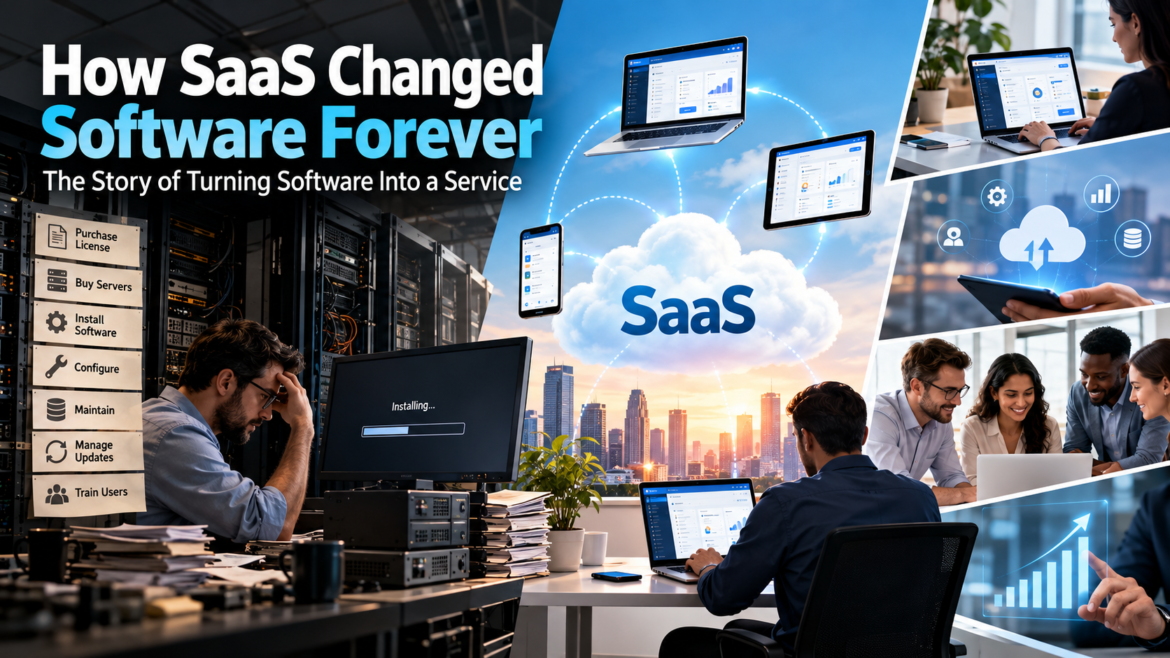
The biggest software revolution may not have been a new programming language or a faster computer. It was the decision to stop selling software as something you own and start delivering it as something you use.
For decades, buying business software was a project.
A company would identify a need.
Then it would contact vendors.
Then come demonstrations, negotiations, contracts and licenses.
Servers might have to be purchased.
Software would be installed.
IT teams would configure it.
Employees would be trained.
Updates would have to be planned.
And if the company needed more users, it might have to buy more licenses.
Software was something a company purchased and installed.
Then a different idea began taking shape.
What if companies didn’t have to own the software?
What if they could simply access it through the internet?
What if the vendor maintained the infrastructure, handled updates and continuously improved the product?
And what if customers paid a recurring subscription rather than buying a large software license upfront?
That idea became Software as a Service – SaaS.
Today, SaaS is so normal that we rarely stop to think about how radical it once was.
But the shift fundamentally changed the economics of software.
Before SaaS, software was something you bought
Traditional business software followed a relatively straightforward model.
The customer purchased a license.
The customer installed the software.
The customer’s IT department maintained the environment.
The customer dealt with upgrades.
The customer managed much of the infrastructure.
The vendor delivered software.
The customer operated it.
That model made sense when computing infrastructure was physically located inside the customer’s organization.
But it created enormous friction.
A company didn’t just need software.
It needed the capability to run the software.
That meant servers, storage, networking, databases, administrators, maintenance and technical expertise.
Software wasn’t just a product.
It was an IT project.
The internet changed the question
As internet connectivity improved, a different possibility emerged.
Software didn’t necessarily have to live on every customer’s computer.
It could run on infrastructure operated by the software provider.
Customers could access it through a browser or another network interface.
That seemingly simple change separated software from physical installation.
The U.S. National Institute of Standards and Technology later formalized cloud computing around characteristics including on-demand access, broad network access, resource pooling, rapid elasticity and measured service. NIST defines SaaS specifically as a model in which customers use applications running on cloud infrastructure rather than managing the underlying infrastructure themselves.
But the important part of the story happened before the terminology became standardized.
The market had to learn to trust the idea.
SaaS actually predates the word “cloud”
One of the interesting details in this story is that SaaS wasn’t invented after cloud computing.
NIST notes that the term SaaS dates back to the 1990s and therefore predates the term “cloud computing.”
The underlying concept was already developing:
Software could be hosted remotely and delivered over the internet.
What changed over time was the infrastructure required to make that model practical at enormous scale.
Faster networks.
Cheaper computing.
Virtualization.
Better browsers.
Improved data centers.
More reliable internet connectivity.
Together, these technologies made remote software delivery increasingly practical.
NIST identifies fast wide-area networks, powerful inexpensive server computers and high-performance virtualization as important enabling technologies for cloud computing.
Then came a company with a provocative idea
In 1999, four people – Marc Benioff, Parker Harris, Frank Dominguez and Dave Moellenhoff – began building what would become Salesforce.
The company opened its doors on March 8, 1999.
Its idea was straightforward but controversial:
CRM software should be delivered through the internet rather than installed on a customer’s servers.
Salesforce describes itself as pioneering SaaS by bringing CRM to the cloud in 1999.
At the time, this wasn’t an obvious strategy.
Enterprise software was dominated by large established vendors.
Companies were accustomed to purchasing software licenses and operating their own systems.
The idea that critical business software could simply live somewhere else required a major psychological shift.
“No software” was more than a slogan
Salesforce famously positioned its early proposition around the phrase “No Software.”
The provocative message wasn’t literally that businesses didn’t need software.
It was that businesses didn’t need to think about software in the traditional way.
They didn’t need to install it.
They didn’t need to manage the underlying infrastructure.
They didn’t need to treat every software upgrade as a major IT event.
The product was becoming a service.
And that distinction became the foundation of a new business model.
The real innovation was not the browser
It would be easy to look at SaaS and conclude that its innovation was simply:
“Put software on the internet.”
That undersells what happened.
The deeper innovation was the combination of:
Remote delivery + centralized infrastructure + recurring revenue + continuous updates + scalable access
Together, those elements changed the economics of software.
Software stopped being something a customer acquired once.
It became something the customer continuously consumed.
The subscription model changed everything
Traditional software often generated revenue through large upfront license purchases.
SaaS introduced a different relationship.
Instead of:
Buy → Install → Maintain
the model became:
Subscribe → Access → Use → Renew
Salesforce itself has described its early business around three ideas: cloud technology, a subscription business model and an integrated philanthropy model.
The subscription wasn’t merely a billing mechanism.
It changed the incentives of the entire software company.
Software companies suddenly had to earn the renewal
Under the old licensing model, a vendor could generate substantial revenue when a customer purchased the software.
Under SaaS, the relationship was different.
The company needed customers to continue subscribing.
That created much stronger pressure around:
- Product usability
- Customer satisfaction
- Reliability
- Support
- Continuous improvement
- Feature development
- Retention
- Customer success
The customer wasn’t simply buying a product.
The customer was entering into an ongoing relationship.
That helped create an entirely new business vocabulary.
Churn.
Retention.
Customer lifetime value.
Monthly recurring revenue.
Annual recurring revenue.
Net revenue retention.
These metrics became fundamental to modern software businesses.
The upgrade problem disappeared – or at least moved
Think about traditional enterprise software.
A major software upgrade could involve:
- Planning
- Testing
- IT resources
- Downtime
- Compatibility checks
- Deployment
- Training
With SaaS, the vendor controls much more of the technical environment.
Updates can be deployed centrally.
Customers don’t necessarily have to install a new version manually.
This created one of SaaS’s most important advantages:
software could become continuously updated rather than periodically replaced.
Instead of waiting for “Version 4.0,” customers could receive improvements throughout the life of the service.
SaaS also changed who could buy software
Traditional enterprise software could involve significant upfront investment.
That naturally favored organizations with larger IT budgets and technical teams.
SaaS lowered some of those initial barriers.
A smaller company could subscribe to software without building an entire infrastructure around it.
A startup could use sophisticated CRM, accounting, collaboration, marketing and analytics tools without building them internally.
This contributed to a broader democratization of business technology.
Sophisticated software capabilities increasingly became available to organizations of many sizes.
Then something even bigger happened
Once software could be delivered through the internet, there was no longer a strong reason for every business application to be installed locally.
That opened the door to an enormous ecosystem.
CRM.
Accounting.
Human resources.
Marketing automation.
Project management.
Customer support.
Video conferencing.
Design.
Analytics.
Cybersecurity.
Collaboration.
Payments.
Communication.
Storage.
Almost every business function could potentially become a service.
The result was an explosion of SaaS companies.
The SaaS model created a new kind of startup
Traditional software companies often needed significant resources before they could distribute their products.
SaaS startups could increasingly build a product, host it centrally and allow customers to access it remotely.
That changed startup economics.
The company could continuously release improvements.
Customers could be onboarded without physically installing software on every machine.
Usage could be measured.
Customer behavior could be analyzed.
Pricing could be tested.
New features could be introduced.
And distribution could increasingly happen through the internet.
The software company was becoming a living system rather than a product that periodically shipped new versions.
SaaS and cloud computing became inseparable
The terms SaaS and cloud computing are often used interchangeably, but they aren’t exactly the same.
NIST identifies three major cloud service models:
SaaS – Software as a Service
PaaS – Platform as a Service
IaaS – Infrastructure as a Service
In SaaS, the customer uses an application.
In PaaS, developers use a platform to build or deploy applications.
In IaaS, customers consume underlying computing infrastructure.
So SaaS is best understood as one layer of the broader cloud ecosystem.
The software company became a service company
This is one of the biggest conceptual changes.
In the old model, the product was software.
In the SaaS model, the product is closer to:
Software + Infrastructure + Availability + Support + Updates + Data + Service
The customer isn’t simply buying code.
They are buying an ongoing capability.
That is why SaaS companies increasingly behave differently from traditional software vendors.
Their job isn’t finished when the software ships.
In many ways, that’s when the relationship begins.
The marketplace became more important than the application
As SaaS expanded, another development emerged.
A company didn’t necessarily want ten completely isolated SaaS applications.
It wanted them to work together.
CRM should connect with marketing.
Marketing should connect with analytics.
HR should connect with payroll.
Sales should connect with finance.
Customer support should connect with product data.
That created an enormous market for:
APIs, integrations, marketplaces and platforms.
Salesforce launched AppExchange in 2005, extending its CRM ecosystem with third-party applications and integrations.
That was an important evolutionary step.
SaaS companies were no longer simply selling applications.
They were building ecosystems.
SaaS changed the role of IT
The IT department didn’t disappear.
Its role changed.
Instead of spending all its time installing and maintaining every application internally, IT increasingly became responsible for:
- Architecture
- Security
- Identity
- Access management
- Vendor management
- Integration
- Governance
- Compliance
- Data management
The question shifted from:
“How do we operate this software?”
toward:
“How do we safely integrate and manage the services our organization depends on?”
That is a very different IT function.
But SaaS introduced new problems
Every technological revolution solves some problems while creating others.
SaaS reduced infrastructure burdens for customers.
But it also created new dependencies.
If your software provider goes down, your business may be affected.
If your provider changes its pricing, you may have to respond.
If your data is stored externally, security and privacy become critical.
If hundreds of SaaS applications are used across an organization, managing identities and permissions becomes complicated.
And if employees adopt SaaS applications without IT oversight, companies can develop shadow IT.
The convenience of SaaS therefore created a new responsibility:
governance.
NIST has dedicated guidance specifically to access control in cloud systems, reflecting the security and authorization challenges associated with cloud service models.
The subscription economy extended beyond software
Once consumers and businesses became comfortable paying recurring subscriptions for digital services, the model expanded far beyond traditional enterprise software.
Streaming.
Music.
Cloud storage.
Design tools.
News.
Gaming.
Education.
Fitness.
Productivity.
The underlying psychological shift was significant.
People became increasingly comfortable paying for continued access rather than permanent ownership.
That is a business-model revolution.
SaaS also changed the economics of innovation
In the traditional model, releasing a major improvement could be expensive and slow.
In SaaS, a company can potentially develop, test, deploy and measure improvements continuously.
That creates a feedback loop:
Customer uses product → Company collects feedback/data → Product improves → Customer uses improved product
The software becomes increasingly shaped by real-world usage.
That doesn’t automatically mean every SaaS product becomes better.
But the economic structure encourages continuous iteration.
The irony: SaaS made software feel less like software
Think about how people use SaaS today.
They don’t necessarily think:
“I’m running a cloud application hosted on remote infrastructure.”
They think:
“I’m using Slack.”
“I’m checking Salesforce.”
“I’m editing a document.”
“I’m opening Canva.”
“I’m joining a Zoom meeting.”
The infrastructure has disappeared behind the interface.
That is one of the defining characteristics of successful technology:
the complexity becomes invisible.
SaaS prepared the world for AI
There is another reason the SaaS story matters today.
Modern AI products are increasingly delivered through the same service infrastructure.
You don’t necessarily download a giant AI system and install it on your laptop.
You access a service.
The provider operates the infrastructure.
The model is updated centrally.
Capabilities can be introduced over time.
Pricing can be subscription-based or usage-based.
APIs allow other businesses to build on top of the service.
In other words:
SaaS created much of the commercial and technical vocabulary that today’s AI services are using.
The AI revolution is not replacing the SaaS model.
In many cases, it is building on top of it.
The next transformation: Software as an intelligent service
SaaS originally changed:
Where software lives.
Then it changed:
How software is purchased.
Now AI is beginning to change:
What software actually does.
Traditional SaaS largely waits for humans to interact with an application.
AI-enabled software increasingly attempts to understand context, predict needs and perform tasks.
That could lead to another evolution:
Software as a service → Intelligence as a service → Work as a service
The exact future is still being defined.
But the pattern is familiar.
A new layer of technology changes the abstraction.
What entrepreneurs can learn from SaaS
The SaaS revolution offers lessons far beyond software.
1. Change the business model, not just the product
The breakthrough wasn’t simply delivering software through a browser.
It was changing the relationship between vendor and customer.
2. Remove friction
Every step you remove from adoption increases the possibility of adoption.
Installation is friction.
Hardware is friction.
Complex upgrades are friction.
SaaS attacked those barriers.
3. Recurring revenue changes company behavior
When customers can leave every month or year, retention becomes a strategic priority.
4. Build ecosystems
A successful product can become far more valuable when other companies can build around it.
5. Don’t confuse ownership with value
Customers don’t necessarily need to own technology.
They need the outcome the technology provides.
That’s a profound distinction.
The bigger idea behind SaaS
The most important thing Salesforce and the broader SaaS movement changed wasn’t software delivery.
It was the relationship between technology and the customer.
The old model said:
Here is the software. Install it.
The SaaS model said:
Here is the capability. Use it.
That sounds like a subtle difference.
It isn’t.
One is a product transaction.
The other is an ongoing relationship.
And once that relationship became normal, it changed how companies built software, priced software, distributed software, supported customers and measured success.
From software you own to capabilities you access
Today, we barely question the idea that a company can subscribe to technology.
A five-person startup can use enterprise-grade CRM.
A small marketing team can access sophisticated analytics.
A freelancer can use professional design software.
A global corporation can run thousands of cloud applications.
The infrastructure behind all of this is extraordinarily complex.
But the customer experience is remarkably simple:
Log in.
That simplicity is the legacy of the SaaS revolution.
The technology industry spent decades making computers more powerful.
SaaS helped make access to computing power more ordinary.
And that may be its greatest contribution.
The most transformative technology isn’t always the technology users notice.
Sometimes it is the technology that quietly changes the economic model underneath everything else.
SaaS did exactly that.
It took software from something companies bought and installed and turned it into something they increasingly access, consume and continuously use.
And once that happened, the software industry was never quite the same again.