
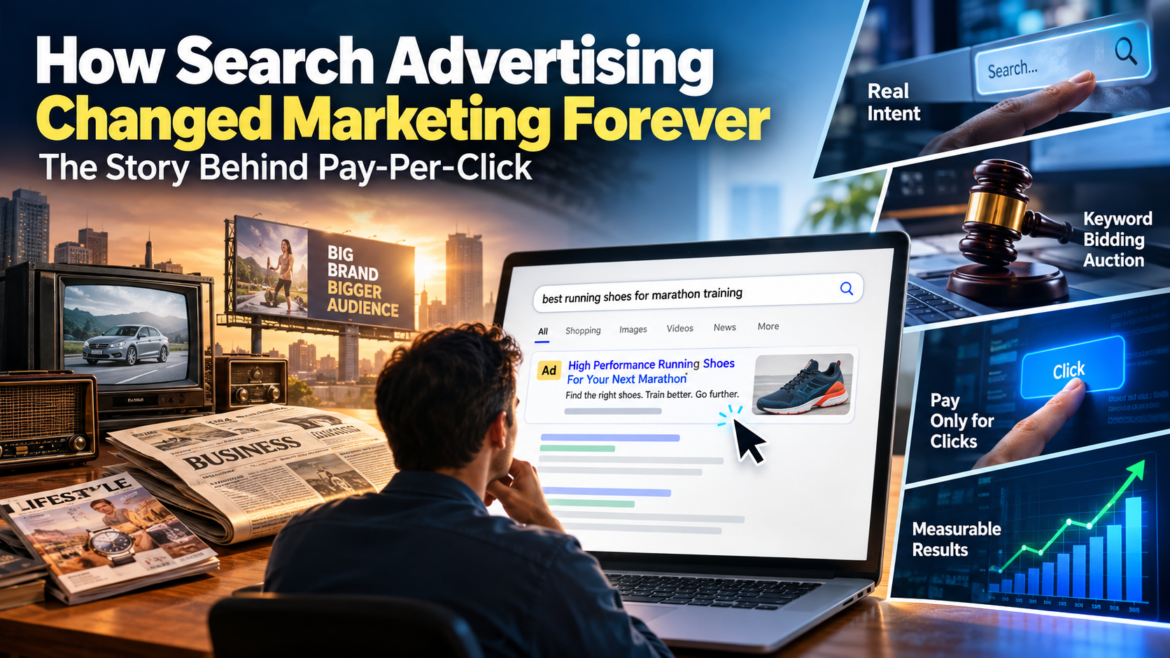
Before search advertising, marketers paid to reach audiences. Then the internet introduced a radically different question: what if advertisers could pay only when someone actually showed interest?
Imagine being a marketer in the late 1990s.
You want to advertise your business.
Your options are familiar: television, radio, newspapers, magazines, billboards, direct mail and banners on websites.
The basic bargain is the same.
You pay for exposure.
Whether somebody notices your advertisement, cares about it, visits your store or eventually becomes a customer is largely someone else’s problem.
Then a small internet company called GoTo.com introduced an idea that sounded almost too simple:
Don’t charge advertisers simply because their advertisement was displayed. Let them bid for search terms and pay when someone clicks.
That idea helped create what we now call pay-per-click advertising.
Google later turned the concept into a vastly larger advertising ecosystem through AdWords – now Google Ads.
And in doing so, search advertising changed one of the oldest assumptions in marketing:
Advertising didn’t have to be purchased purely as attention. It could be purchased as measurable intent.
That was a profound shift.
The problem with advertising was never simply reach
Advertising has always had a measurement problem.
A television commercial might be seen by millions of people.
But how many were interested in the product?
A newspaper advertisement could occupy an entire page.
But how many readers actually wanted what was being advertised?
Even early internet advertising inherited this problem.
The first major banner advertisement appeared on the web in 1994. Advertisers could buy space and measure impressions and clicks, but the basic transaction was still largely about buying exposure.
The internet had made advertising measurable in new ways, but it hadn’t completely changed the underlying economic model.
Then search engines introduced something different.
A search query contained a clue.
A person wasn’t merely looking at media.
They were asking for something.
That distinction would become incredibly valuable.
Search was different from almost every other advertising environment
Consider two people.
Person A sees a banner advertising running shoes while reading an article.
Person B types:
“Best running shoes for marathon training”
Both people might eventually buy running shoes.
But their levels of demonstrated intent are very different.
The second person has voluntarily expressed a need.
Search engines therefore created something advertising had rarely possessed at scale:
a continuously updated signal of what a person is actively looking for.
The question became:
Could advertising be placed directly in front of someone at the moment they expressed that intent?
In 1998, GoTo.com began experimenting with exactly that idea.
Google would later turn search advertising into a massive global business.
The company that saw the opportunity before Google
The history of pay-per-click advertising is sometimes told as a Google story.
It isn’t.
One of the most important early companies was GoTo.com, founded by Bill Gross as part of Idealab.
Google’s own historical account acknowledges that the origins of search advertising go back to GoTo.com in 1998.
GoTo.com introduced an unusual proposition.
Advertisers could bid on keywords.
The advertiser wasn’t simply buying a billboard on a website.
It was effectively saying:
“I want my business to appear when someone searches for this particular thing.”
And, crucially, advertisers could pay based on clicks.
The idea created a marketplace around commercial intent.
Suddenly, a search query could become an economic event.
The auction changed the relationship between advertisers and publishers
The traditional advertising model largely worked like this:
Publisher → Audience → Advertisement → Advertiser pays
Search advertising introduced something closer to:
Search query → Commercial intent → Advertisement → Click → Advertiser pays
That may look like a small modification.
It wasn’t.
The click became a measurable event.
An advertiser could now ask:
- How many people clicked?
- How much did each click cost?
- Which keywords generated traffic?
- Which ads performed better?
- Which searches generated customers?
Marketing was becoming increasingly accountable to outcomes.
Google initially took a different approach
When Google introduced AdWords in October 2000, it didn’t immediately replicate the complete pay-per-click auction model that would later define Google advertising.
The initial system was based on advertising purchased around search keywords and was charged on an impression basis.
Google’s later evolution of the product moved toward the pay-per-click model.
Google’s own historical account describes the evolution of search advertising from GoTo.com’s 1998 model to Google’s introduction of AdWords in 2000.
This distinction is important because the story isn’t simply:
Google invented PPC.
It didn’t.
The more interesting story is:
Google took an emerging advertising model and integrated it with its search engine, data, algorithms and enormous scale.
Then Google discovered something even more important
Paying for a click was useful.
But there was a problem.
What happens if advertisers simply bid the most money?
The company with the largest budget could potentially dominate the most valuable keywords.
That creates a bad experience.
Imagine searching for:
“cheap flights to London”
and being shown an advertisement from a company that bid aggressively but had little relevance to your search.
Google had a problem to solve:
How do you make advertising economically valuable without making search results less useful?
The answer became one of the defining principles of modern search advertising:
relevance matters.
Google’s filings from the period explicitly identified the relevance and quality of advertisements, as well as click-through rates, as factors affecting advertising monetization.
That created a powerful alignment.
Google wanted users to click useful advertisements.
Advertisers wanted qualified users to click.
Users wanted advertisements that were relevant to what they were searching for.
The advertising system could therefore reward relevance rather than simply rewarding the deepest pocket.
The keyword became a new kind of marketing asset
Before search advertising, marketers often thought about audiences.
Men aged 25-44.
Business executives.
Homeowners.
Parents.
Sports fans.
Search advertising introduced another unit of thinking:
The keyword.
A keyword wasn’t simply demographic information.
It could represent a problem.
A question.
A desire.
An immediate commercial need.
Consider the difference:
Audience targeting:
“People interested in enterprise software.”
versus:
Search intent:
“Best CRM software for 500 employees.”
The second statement contains significantly more information about what the person might want to do.
This changed marketing strategy.
Marketers began building campaigns around intent, not just audience characteristics.
Marketing became measurable at an entirely different level
Search advertising also changed reporting.
Traditional advertising could measure reach, impressions, circulation or estimated audience size.
Digital advertising introduced much more granular metrics.
A marketer could see:
Impressions → Clicks → Cost → Conversion
That meant marketers could calculate metrics such as:
- Cost per click
- Click-through rate
- Conversion rate
- Cost per acquisition
- Return on advertising spend
The marketing department was increasingly able to connect media expenditure to measurable customer actions.
This didn’t make advertising perfectly measurable.
A click isn’t a sale.
A conversion isn’t necessarily profitable.
Attribution remains complicated.
But the fundamental economics had changed.
Marketing was becoming increasingly performance-oriented.
Small businesses suddenly had a new way to compete
This may be one of the most important consequences of search advertising.
A small business doesn’t need to buy a national television campaign to appear when someone searches for its product.
It can potentially compete for a specific search term with a relatively controlled budget.
A local plumber can advertise for:
“emergency plumber near me”
A software company can advertise for:
“HR software for small business”
A lawyer can target:
“employment lawyer in [city]”
A B2B company can target highly specific commercial queries.
This created a new form of advertising democratization.
The advertiser didn’t necessarily need enormous media buying power.
They needed:
relevance + an offer + a landing page + a willingness to compete in the auction.
And then something extraordinary happened
The advertising marketplace itself became automated.
Instead of calling a newspaper salesperson, negotiating a placement and waiting for the campaign to run, advertisers could increasingly:
- Select keywords
- Write advertisements
- Set budgets
- Bid on searches
- Measure clicks
- Adjust campaigns
- Repeat
The advertising relationship became software.
That was a major shift.
Advertising stopped being only a media-buying activity and became a technology platform.
Google built a business around the model
The economics became enormously important to Google.
In Google’s 2004 SEC filing, advertising accounted for 99% of the company’s revenue that year.
The company’s later filings describe AdWords as an automated program through which advertisers placed targeted ads, with most AdWords customers paying on a cost-per-click basis.
The significance isn’t simply that Google made money from advertisements.
It’s that Google created an infrastructure where:
Users generated searches.
Searches generated intent signals.
Advertisers competed for relevant opportunities.
Clicks generated revenue.
Revenue supported the search ecosystem.
The search engine and advertising marketplace became economically interconnected.
The search engine became a marketplace for intent
This is perhaps the deepest idea behind search advertising.
Google wasn’t merely selling advertising space.
It was effectively operating a marketplace around expressed demand.
A user enters:
“best accounting software”
That query tells the system something.
Someone has a problem.
Businesses that solve that problem want access to that person.
Google sits between them.
The advertiser wants the customer.
The customer wants an answer.
Google wants to provide the answer while monetizing the interaction.
That three-way relationship became one of the defining business models of the internet.
It also changed how companies thought about their websites
Once companies could measure search traffic, another question emerged:
What happens after the click?
That led to the rise of landing-page optimization.
Marketers began experimenting with:
- Headlines
- Calls to action
- Forms
- Offers
- Page layouts
- Pricing
- Content
- Trust signals
- Conversion paths
The advertisement was no longer the complete campaign.
The entire journey mattered.
Search query → Advertisement → Landing page → Conversion
This helped accelerate the growth of what would eventually become the broader conversion-rate optimization industry.
Search advertising also helped create the modern performance marketing industry
Once marketers could measure actions, agencies began specializing in those actions.
Search marketing agencies emerged.
PPC specialists emerged.
Bid-management platforms emerged.
Analytics companies emerged.
Landing-page platforms emerged.
Marketing automation expanded.
Conversion optimization became a discipline.
And eventually, the language of marketing changed.
Instead of asking only:
“How many people saw our campaign?”
marketers increasingly asked:
“How many qualified opportunities did the campaign generate?”
That is a very different question.
But Google didn’t invent the entire idea
This distinction matters.
The basic pay-per-click search advertising concept predates Google.
GoTo.com pioneered important elements of the model in 1998, and Google’s later system built on the broader development of paid search.
Google’s historical material itself identifies GoTo.com as an early pioneer of search advertising.
There was also a legal battle over intellectual property.
Overture, the successor to GoTo.com, sued Google over aspects of its advertising system. The dispute was eventually settled in 2004.
Google’s 2004 SEC filing records a $201 million non-recurring charge related to settlement of disputes with Yahoo, reflecting the significance of the legal resolution to the company at the time.
The history therefore isn’t simply a story of one company inventing a model.
It is a story of an idea evolving through multiple companies, technologies and business models.
The biggest innovation wasn’t “pay per click”
It is tempting to reduce the entire story to:
PPC = pay when someone clicks.
But that isn’t the most important innovation.
The deeper innovation was:
Connect advertising expenditure to a measurable expression of user intent.
That is why search advertising became so powerful.
The advertiser wasn’t paying merely because an audience existed.
The advertiser was competing for access to someone who had already expressed a need.
That is a fundamentally different relationship between marketing and the customer.
Search advertising changed the language of marketing
The industry gained a new vocabulary:
Impressions.
Clicks.
CTR.
CPC.
Conversion rate.
CPA.
ROAS.
Quality Score.
Search intent.
Landing-page experience.
These weren’t merely new metrics.
They represented a new way of thinking.
Marketing was becoming increasingly mathematical.
Campaigns could be tested.
Results could be compared.
Budgets could be shifted.
Underperforming advertisements could be paused.
Successful campaigns could be scaled.
The marketer became part advertiser, part analyst and increasingly part technologist.
And now the model is entering another transformation
The keyword-based advertising model that dominated digital marketing for decades is itself evolving.
Search is increasingly becoming conversational.
People are asking longer questions.
They are interacting with AI systems.
They are searching through voice.
They are receiving synthesized answers rather than simply lists of links.
That creates a new question:
If the keyword was the fundamental unit of search advertising, what becomes the fundamental unit when search becomes conversational?
That question is still unfolding.
But the underlying principle may survive:
Businesses will continue wanting to reach people at moments when they demonstrate a need.
The interface may change.
The technology may change.
The auction may change.
The keyword may change.
But intent remains valuable.
What today’s marketers can learn from the birth of search advertising
1. Follow intent, not just demographics
Knowing who someone is can be useful.
Knowing what they are actively trying to solve can be even more valuable.
2. Make measurement part of the product
The greatest marketing platforms don’t merely distribute messages.
They generate feedback.
3. Align incentives
Google’s advertising system became powerful partly because relevance could benefit multiple participants:
User → useful result
Advertiser → qualified traffic
Platform → advertising revenue
When incentives align, marketplaces can scale.
4. Don’t confuse technology with the real innovation
PPC was technology.
Monetizing intent was the bigger business idea.
5. Watch what users are already telling you
Search queries are not merely keywords.
They are clues about problems people are trying to solve.
For marketers, that is an enormous source of insight.
The advertisement that changed advertising
Search advertising didn’t eliminate television.
It didn’t eliminate billboards.
It didn’t eliminate newspapers.
And it didn’t make traditional brand advertising irrelevant.
Instead, it introduced another dimension to marketing:
intent.
For decades, marketers had become exceptionally good at finding audiences.
Search advertising gave them a way to find people at the moment they were actively looking for something.
That changed the economics of digital advertising.
It changed how agencies operated.
It changed how businesses acquired customers.
It changed how marketers measured performance.
And it helped transform search engines from useful internet tools into some of the most powerful commercial platforms ever created.
The remarkable part is that the core idea is incredibly simple.
Someone searches.
A business wants to be found.
A marketplace connects them.
And the advertiser pays when interest becomes action.
That is the idea that helped turn a search box into an advertising machine.
And perhaps the bigger lesson for every marketer is this:
The most valuable audience isn’t always the largest audience. Sometimes it’s the audience that is already looking for you.