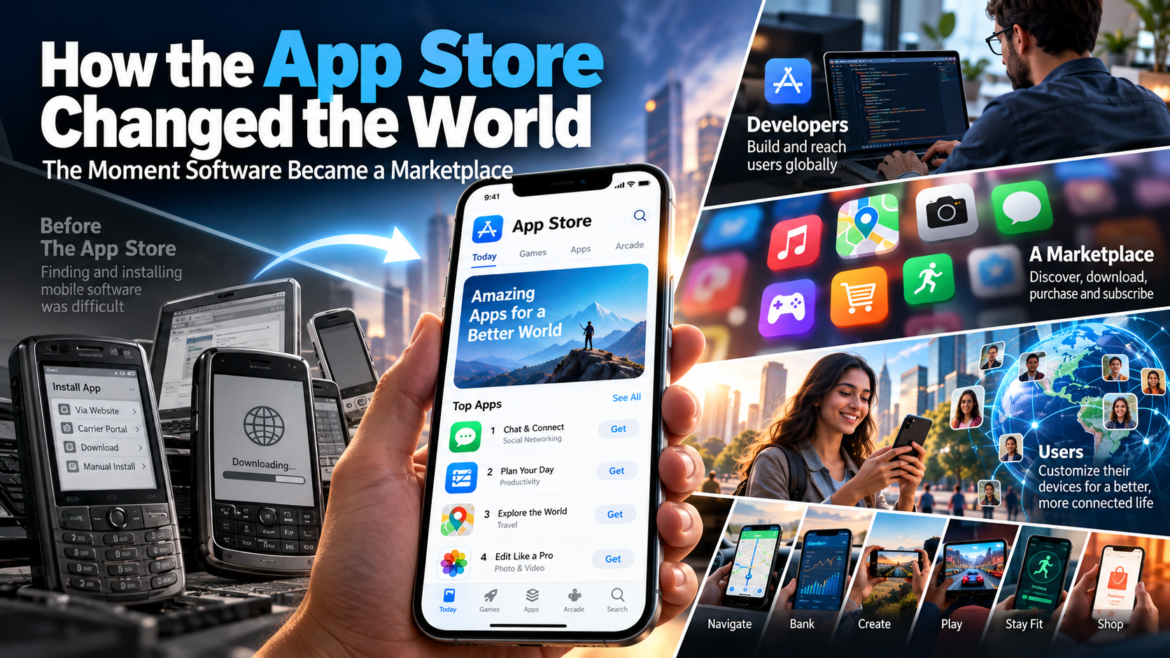
Before the App Store, software was something you installed. After it, software became something you discovered, downloaded, purchased, subscribed to, and carried in your pocket.
In 2007, Apple introduced a product that would change mobile computing: the iPhone.
But the iPhone itself wasn’t the entire revolution.
The more consequential idea arrived one year later.
In July 2008, Apple opened the App Store with just 500 applications.
Today, billions of people routinely download software onto devices in seconds. Businesses build entire companies around mobile applications. Developers can distribute software globally without negotiating with physical retailers. Consumers expect new features to appear through updates rather than new hardware.
The App Store helped create that world.
And its most important contribution wasn’t simply making apps easier to download.
It created a marketplace between developers and users.
That changed software distribution, entrepreneurship, consumer behavior, and eventually the economics of the smartphone itself.
Before the App Store, mobile software was difficult
The idea of installing software on a phone wasn’t new in 2008.
Mobile devices had already supported applications for years.
But the experience was fragmented.
Developers had to deal with different operating systems, hardware configurations, distribution channels, carriers, and technical requirements.
Users often had to find applications through websites, specialized stores, carrier portals, or other mechanisms.
There was no universally obvious answer to a simple question:
“Where do I get software for my phone?”
Apple’s answer was surprisingly simple:
Create one place where users can find applications and developers can distribute them.
That sounds obvious today.
It wasn’t obvious then.
The iPhone created the platform
When Apple introduced the original iPhone in January 2007, the company initially positioned it primarily as a tightly integrated device rather than an open platform for third-party applications.
Steve Jobs famously demonstrated the iPhone’s built-in capabilities while emphasizing web applications as one way developers could extend the device.
But developers wanted something more powerful.
They wanted to build software that could access the capabilities of the device itself.
The pressure eventually resulted in a formal software development platform.
In March 2008, Apple announced the iPhone SDK, giving developers tools to create native applications for the iPhone and iPod touch. Apple also announced plans for an App Store where those applications could be distributed.
This was the critical step.
Apple wasn’t simply building a phone.
It was building a platform.
The 500-app beginning
When the App Store launched on July 10, 2008, Apple offered approximately 500 applications.
That number sounds almost comically small today.
But the significance wasn’t the number.
It was the architecture.
Apple had created a system in which:
Developer → builds application
Apple → reviews and distributes it
User → discovers and downloads it
Apple → processes the transaction
Developer → receives a share of the revenue
Software distribution had become a marketplace.
Apple later reported that the App Store reached more than 10 million downloads in its first three days.
The behavior was beginning to form.
People weren’t simply buying phones anymore.
They were beginning to customize what their phones could do.
The smartphone became programmable
This is the deeper idea behind the App Store.
Before app marketplaces, consumers primarily bought a device based on what the manufacturer had already built into it.
The functionality of the device was largely predetermined.
The App Store changed that relationship.
A smartphone could now become:
- A banking terminal
- A navigation device
- A camera editor
- A music player
- A game console
- A fitness tracker
- A shopping tool
- A social network
- A productivity system
- A communication platform
The hardware was only the starting point.
The software ecosystem determined much of what the device could become.
That transformed the smartphone from a product into a platform.
Apple didn’t invent the app
This distinction is important.
Applications existed long before the App Store.
Personal computers had software ecosystems.
Websites provided interactive services.
PDAs and smartphones already had third-party applications.
What Apple changed was the distribution model.
It combined:
Discovery + distribution + payments + installation + updates + platform integration
into a single consumer experience.
That combination was extraordinarily powerful.
The App Store solved a distribution problem
Imagine being an independent developer in 2008.
You have an idea for a mobile application.
You can build it.
But how do you reach customers?
You could create a website.
You could advertise.
You could try to work with carriers.
You could distribute software through other channels.
None of these approaches provided the simplicity of a built-in marketplace.
The App Store changed the equation.
A developer could build an application and potentially make it available to iPhone users around the world through Apple’s platform.
The store became the distribution infrastructure.
That dramatically reduced one of the biggest barriers in software:
getting the product into the customer’s hands.
The marketplace effect began
The App Store also created a classic marketplace dynamic.
Developers wanted users.
Users wanted useful applications.
Apple needed both.
The more developers created compelling applications, the more useful the iPhone became.
The more useful the iPhone became, the more consumers wanted iPhones.
The more iPhones existed, the more attractive the platform became to developers.
That created a reinforcing loop:
More users → more developers → more apps → more value → more users
This is a form of network effect.
The value of the platform increasingly depended not only on Apple’s hardware but on the ecosystem surrounding it.
Then came the unexpected entrepreneurs
One of the most important consequences of the App Store was that it created a new path to entrepreneurship.
Before app marketplaces, building a software business often required:
- Distribution relationships
- Retail infrastructure
- Sales teams
- Corporate contracts
- Physical packaging
- Significant marketing budgets
The App Store dramatically lowered some of those barriers.
A small development team could create a product and distribute it globally.
That didn’t guarantee success.
The App Store quickly became crowded and competitive.
But the fundamental barrier had changed.
A developer didn’t necessarily need to convince a retail chain to stock a product.
They needed to convince users to download it.
The $0.99 software economy
One of the most interesting early experiments was pricing.
Developers could charge relatively small amounts for applications.
A game might cost $0.99.
A utility might cost a few dollars.
The friction of purchasing software became extremely low.
This helped normalize the idea that digital products could be bought in tiny transactions.
But the economics eventually evolved.
The industry moved through several models:
Paid apps
then:
Free apps
then:
Advertising-supported apps
then:
Freemium
then:
In-app purchases
and increasingly:
Subscriptions
The App Store didn’t just create a marketplace.
It became a laboratory for digital pricing.
Freemium changed mobile business models
One of the most important developments in the mobile economy was the rise of freemium.
Instead of asking users to pay before trying an application, developers could give away the basic product and monetize advanced features, virtual goods or subscriptions.
This dramatically changed customer acquisition.
The question became:
How many people can we get to try the product?
rather than:
How many people can we convince to buy the product before experiencing it?
That model spread far beyond mobile applications.
It became common in:
- SaaS
- Games
- Productivity software
- Consumer services
- Media
- Online communities
The app economy helped make free-to-start software a mainstream business strategy.
The App Store transformed gaming
Gaming may have been one of the biggest beneficiaries.
Mobile games could be distributed directly to millions of people.
Developers could update games continuously.
New content could be introduced.
Virtual items could be sold.
Social features could be added.
The smartphone became a serious gaming platform.
Companies built enormous businesses around mobile games.
The economics of gaming changed from:
Buy game → own game
toward:
Download game → play → purchase additional content
That shift had enormous consequences for game design and monetization.
Apps also changed entire industries
Once the smartphone became a platform, companies began asking a different question.
Not:
“How do we build a mobile version of our website?”
But:
“What can we build if the smartphone becomes part of our business model?”
That difference matters.
Banking apps changed how people interact with financial institutions.
Ride-hailing applications changed transportation.
Food-delivery apps changed restaurants’ relationship with customers.
Travel applications changed booking.
Social apps changed communication.
Fitness applications changed personal health tracking.
Retail applications changed shopping.
The smartphone became a gateway to services rather than simply a communication device.
The App Store also created a new marketing problem
Success became difficult for a different reason.
There were now too many applications.
A developer could build a great product and still fail because nobody discovered it.
This created an entirely new discipline:
App Store Optimization – ASO.
Developers began thinking about:
- App names
- Keywords
- Descriptions
- Screenshots
- Ratings
- Reviews
- Rankings
- Conversion rates
In other words, the App Store created a miniature search-and-discovery economy.
The same fundamental problem that existed on the web emerged again:
How do you get discovered when everyone is publishing?
That question should sound familiar to every digital marketer.
Reviews became part of the product
The App Store also gave consumers something traditional software distribution often lacked:
immediate feedback from other users.
Ratings and reviews became a major part of software discovery.
A consumer could evaluate an application before downloading it.
Developers could receive feedback directly.
Poor experiences could become visible quickly.
Good experiences could help applications spread.
The marketplace therefore created a feedback loop:
Build → Release → Measure → Learn → Improve
That feedback loop became one of the defining characteristics of modern digital products.
Updates changed what “buying software” meant
Traditional software was often released as a version.
You bought Version 2.
Later, Version 3 arrived.
You might have to pay again.
App distribution introduced a much more fluid model.
Developers could continuously update their applications.
Bugs could be fixed.
Features could be added.
Interfaces could be redesigned.
Security vulnerabilities could be addressed.
The product was no longer static.
It became a continuously evolving service.
That helped accelerate the broader transition from software as a product to software as a service.
Apple became the gatekeeper
The App Store model had another important characteristic.
Apple controlled the platform.
Applications went through Apple’s review process.
Apple controlled the technical rules.
Apple controlled the distribution channel.
Apple controlled the payment infrastructure for many transactions.
This gave Apple significant influence over what software could exist on its platform and how it could be monetized.
That control became both a strength and a source of controversy.
From Apple’s perspective, centralized control helped provide security, consistency and a predictable user experience.
From developers’ perspectives, it meant operating under rules established by another company.
The tension between platform control and developer freedom would become one of the defining debates of the app economy.
The economics became enormous
The App Store eventually became a major global digital marketplace.
Apple’s services business grew substantially as the ecosystem expanded.
The company’s annual reports identify the App Store as part of its Services business alongside areas such as advertising, cloud services, payment services and digital content.
Apple’s financial reporting also makes clear that the company receives commissions from many transactions conducted through its ecosystem.
The important economic insight is this:
Apple didn’t have to build every application.
It created the platform on which other companies could build businesses.
That is the power of a marketplace model.
The platform became more valuable than the individual application
Imagine Apple had built 100 excellent applications.
That would have created a useful device.
But Apple enabled millions of developers to build on the platform.
That created something much larger:
an ecosystem.
This is one of the most important lessons from platform businesses.
A company doesn’t necessarily need to create all the value itself.
It can create the environment in which other people create value.
That idea extends far beyond mobile applications.
Amazon Marketplace.
YouTube.
Shopify.
Salesforce AppExchange.
Microsoft Windows.
Android.
Cloud platforms.
All demonstrate different versions of the same principle:
Platforms scale partly by allowing others to build on top of them.
The App Store changed venture capital thinking
The rise of mobile applications also influenced startup investment.
A small team could potentially create a consumer application with global distribution.
That made certain types of businesses dramatically more capital-efficient.
Instead of building:
- Warehouses
- Retail stores
- Distribution centers
- Physical products
a startup could build:
Code + infrastructure + user acquisition
That didn’t make startups easy.
In fact, competition became brutal.
But it changed what could be attempted by a small team.
The cost of experimentation fell.
And when experimentation becomes cheaper, more experiments happen.
The smartphone became the world’s remote control
This may be the App Store’s biggest cultural consequence.
The smartphone stopped being primarily a phone.
It became a personal interface to hundreds of services.
Think about what your phone can represent today:
Bank
Map
Camera
Wallet
Ticket
Music player
Television
Office
Shopping mall
Game console
Newsstand
Social network
Authentication device
The hardware remained relatively small.
The functionality exploded because software could be continuously added.
The App Store was one of the mechanisms that made this possible at consumer scale.
What the App Store taught businesses about platforms
There are several important lessons.
1. Distribution can be as valuable as the product
A great product with no distribution may struggle.
A platform with built-in distribution can become extraordinarily powerful.
2. Reduce friction
The App Store compressed a complicated process into a few actions:
Discover → Download → Install → Use
That simplicity was a competitive advantage.
3. Build an ecosystem, not just a product
When others can build on your infrastructure, your product can grow beyond what your own organization can create.
4. Make experimentation cheap
Digital products can be launched, measured and improved continuously.
5. Control has economic value
The company controlling the platform often controls important parts of the economics surrounding it.
That is why platform governance matters.
6. Discovery becomes the next problem
Once creation becomes easy, attention becomes scarce.
The App Store solved distribution.
It didn’t eliminate competition.
It created a new competition for discovery.
The App Store’s bigger legacy
The most important thing Apple created wasn’t an icon on an iPhone.
It was a new relationship between:
Developers
Platforms
Consumers
Developers gained global distribution.
Consumers gained an enormous selection of software.
Apple gained a powerful ecosystem and a recurring Services business.
And the smartphone became something much bigger than the device Apple originally introduced in 2007.
The App Store helped establish a model that now feels obvious:
A computing platform becomes more valuable when thousands or millions of other people can build on it.
That idea is now everywhere.
Cloud computing.
AI platforms.
Creator platforms.
Payment platforms.
E-commerce marketplaces.
Developer ecosystems.
The underlying principle is the same.
Build the infrastructure.
Create the rules.
Give others the tools.
Let an ecosystem grow.
The next App Store moment may be AI
There is an interesting parallel emerging today.
The App Store transformed mobile software by creating a marketplace for applications.
AI is now creating a new question:
What happens when software itself becomes capable of performing tasks?
Instead of downloading an application to perform a function, users may increasingly interact with AI systems that can call tools, access services and complete workflows.
The unit of software may gradually move from:
Application
to:
Agent
And the marketplace may evolve from:
App Store
to:
AI ecosystem
It is too early to know exactly what that future will look like.
But history provides a useful clue.
When a new platform dramatically reduces the cost of creating and distributing software, entrepreneurs usually find uses that the platform’s creators didn’t originally imagine.
That is precisely what happened in 2008.
From 500 apps to an economy
The App Store started with roughly 500 applications.
That number is almost irrelevant now.
The important number was one:
One marketplace.
One distribution mechanism.
One place where developers and consumers could meet.
That simple idea helped transform software from something relatively difficult to obtain into something people could discover instantly.
It turned the smartphone into a platform.
It created new business models.
It changed software pricing.
It created new entrepreneurial opportunities.
It created new marketing disciplines.
It helped turn digital services into everyday utilities.
And perhaps most importantly, it demonstrated something fundamental about technology:
The biggest platform businesses don’t necessarily win by creating everything themselves. They win by creating an environment where millions of other people can create value.
The App Store didn’t just sell applications.
It created an economy around them.
And that economy changed the world.