
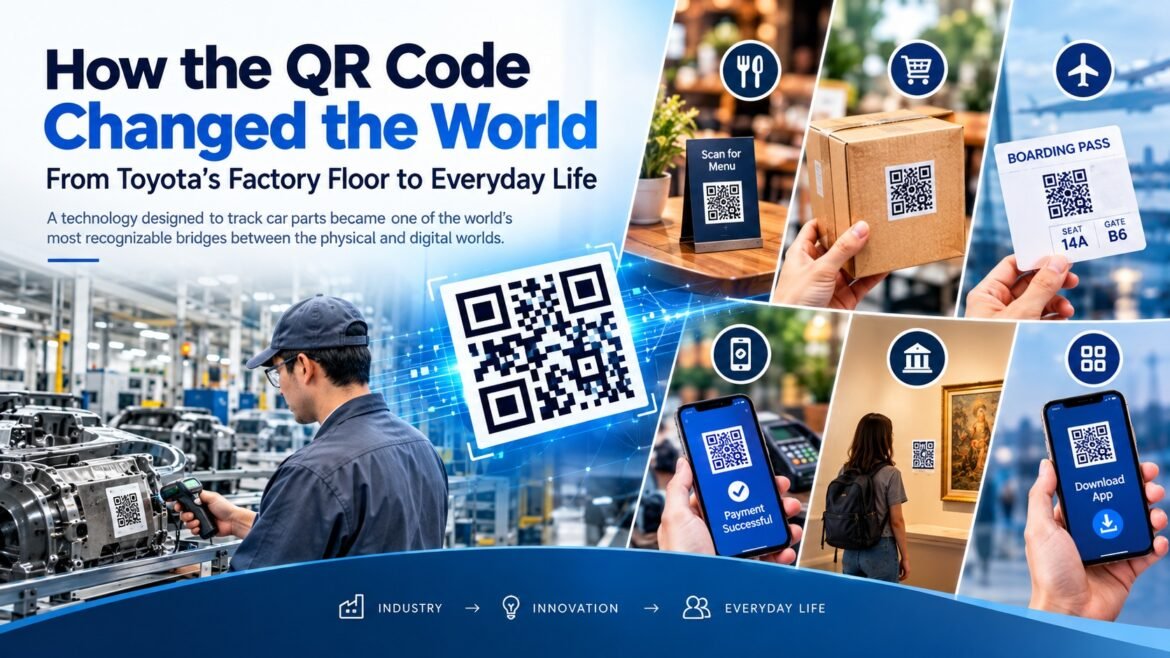
A technology designed to track car parts became one of the world’s most recognizable bridges between the physical and digital worlds.
Walk into a restaurant and you may see one on the table.
Buy a product and there may be one on the packaging.
Board a flight and there may be one on your ticket.
Pay for something and your phone may ask you to scan one.
Visit a museum, attend an event, download an app, open a website or verify a transaction – and there is a good chance a small black-and-white square is somewhere in the process.
The technology is the QR Code.
What makes its story remarkable is that it was never originally designed for consumers.
It wasn’t created for advertising.
It wasn’t created for smartphones.
It wasn’t created for digital payments.
It was created because a Japanese manufacturing company had a very practical problem: traditional barcodes weren’t carrying enough information. And that simple industrial problem eventually produced one of the most widely recognizable interfaces between the physical and digital worlds.
The problem started with the barcode
By the 1980s, barcodes had become an important part of manufacturing, retail and logistics.
They were extremely useful because machines could read information far faster and more reliably than people could enter it manually.
But barcodes had a fundamental limitation.
They were essentially one-dimensional.
As manufacturing became more complex, companies needed to store more information in smaller spaces. DENSO, a Japanese automotive supplier, was already working with barcode readers and manufacturing information systems when the limitations of conventional barcodes became increasingly apparent.
The automotive industry was moving toward producing greater varieties of products in smaller production runs. That meant factories needed to manage more information about individual components and processes.
A traditional barcode simply couldn’t keep up.
DENSO’s engineers began looking for something fundamentally different.
Not a slightly better barcode.
A new kind of code.
Two engineers and a very different idea
In 1992, DENSO began a project to develop a new two-dimensional code.
The development team was remarkably small.
Just two people initially worked on the project.
The team was led by engineer Masahiro Hara.
Their objective wasn’t simply to squeeze more information into a smaller space.
They wanted something that could be read quickly and reliably, including in the difficult conditions of a manufacturing environment.
That distinction mattered.
Factories aren’t pristine laboratories.
Labels can become dirty. Components can be positioned differently. Production lines need speed.
The team therefore designed the new code around several requirements:
- More information capacity
- Faster scanning
- Compact printing
- Greater resistance to damaged or dirty labels
- The ability to encode different types of information
- Easy recognition by scanners
After roughly two years of development, the new system was ready.
In 1994, DENSO introduced the QR Code. The “QR” stood for Quick Response – reflecting the emphasis the engineers had placed on fast reading.
Why does a QR Code look the way it does?
One of the most recognizable characteristics of a QR Code is the three large square patterns positioned near its corners.
They aren’t decoration.
They serve an important purpose: helping a scanner identify the code and determine its orientation.
This was crucial because a QR Code didn’t need to be presented in only one direction.
A conventional barcode generally has a relatively fixed orientation.
A QR Code could be approached from different angles and still be recognized.
That seemingly simple design decision was one of the reasons the technology could eventually move beyond controlled factory environments.
The engineers were designing for machines. They accidentally created something that would work extraordinarily well in a world filled with cameras.
The decision that changed everything
The QR Code might have remained an industrial technology.
But DENSO made a decision that dramatically changed its trajectory.
The company made the specifications publicly available and chose not to enforce its patent rights against people using the technology.
In other words, organizations could use QR Codes without having to negotiate a traditional licensing arrangement with DENSO.
That was an important strategic decision.
Instead of asking:
“How do we control this technology?”
the company effectively asked:
“How do we get as many people as possible to use it?”
The distinction is enormous.
The more organizations adopted the format, the more useful it became.
And the more useful it became, the more organizations had a reason to adopt it.
That is a classic example of how openness can accelerate technological adoption.
DENSO itself says that this approach was intended to allow QR Codes to be used as widely as possible.
The QR Code leaves the factory
The original purpose of the QR Code was industrial.
But technology has a habit of finding problems its creators never anticipated.
The QR Code began appearing in areas outside automotive manufacturing.
It was used for product management and eventually appeared on consumer packaging.
DENSO’s historical account notes that contact-lens packaging was among the early consumer-facing applications because the technology could store substantial information in a relatively small area.
The important transition was beginning:
QR Code was no longer simply a manufacturing technology.
It was becoming a general-purpose information technology.
Then the smartphone arrived
This is where the story gets particularly interesting.
A QR Code is useful only if people have a practical way to scan it.
Early mobile phones with QR Code-reading capabilities began appearing in Japan around 2002.
Suddenly, a printed square could become a gateway to a digital experience.
Scan the code and you could reach a website.
Access a coupon.
Retrieve information.
Open a digital service.
The physical object and the internet could suddenly be connected with a camera.
DENSO describes this period as a major factor in the QR Code’s expansion.
And this created a fascinating new possibility for marketers.
The physical world could now have a hyperlink
Think about what a hyperlink does.
You see text on a screen.
You click it.
You arrive somewhere else.
QR Codes effectively brought that concept into the physical world.
A billboard could contain a digital destination.
A product package could contain additional information.
A restaurant menu could connect customers to an online ordering system.
A magazine advertisement could send a reader to a website.
A business card could point to a digital profile.
A poster could become an interactive experience.
The QR Code became a kind of physical hyperlink. And that changed the possibilities for marketing.
QR Codes and the rise of measurable offline marketing
Traditional offline advertising has always had a measurement problem.
Imagine a billboard.
Thousands of people may see it.
But how many actually responded?
How many visited the company’s website?
How many became customers?
Historically, marketers had limited ways to connect an offline advertisement with a measurable digital action.
QR Codes helped bridge that gap.
A customer could scan an advertisement and be taken directly to a digital destination.
That meant marketers could potentially connect:
Physical advertisement → Scan → Digital experience → Conversion
The QR Code itself wasn’t the marketing strategy.
It was the bridge.
And that distinction is important.
The technology became powerful because it connected two previously separate environments.
Then QR Codes became part of payments
The technology found another major application in financial transactions.
QR-based payments allowed a customer to use a smartphone to interact with a merchant’s payment system.
Instead of exchanging cash or entering card information manually, a QR Code could become part of the transaction process.
This has become particularly important in markets where smartphone-based digital payments have grown rapidly.
The COVID-19 pandemic also accelerated the visibility of QR-based interactions in many markets, including payments, health credentials, check-ins and contactless experiences.
Research examining QR-code adoption during the pandemic documented how health-related QR systems and demand for contactless transactions contributed to increased use in some markets.
In India, QR-based digital payments have become especially visible as part of the country’s broader digital-payments ecosystem.
The result is remarkable:
A technology created to track automobile components became part of how people pay for everyday purchases.
The pandemic changed people’s relationship with QR Codes
Before the pandemic, many people encountered QR Codes occasionally.
After 2020, they became significantly more visible in everyday environments.
Restaurants used them for menus.
Businesses used them for contactless interactions.
Events used them for digital tickets.
Organizations used them for information and verification.
Payments increasingly became part of the experience.
The QR Code suddenly made intuitive sense:
Point your phone at something physical, and something digital happens.
That behavior became familiar to millions of people.
The pandemic didn’t invent QR Codes.
It helped accelerate their integration into everyday experiences.
Why did QR Codes succeed?
The QR Code’s success wasn’t caused by one feature.
It was the combination of several.
1. It solved a real problem
The technology originated from a genuine operational need.
It wasn’t created because someone wanted to invent a futuristic gadget.
It was created because existing technology wasn’t good enough.
2. It was compact
A large amount of information could be represented in a relatively small physical area.
3. It was fast
Speed was part of the original design philosophy.
4. It connected physical and digital environments
This eventually became one of its greatest advantages.
5. Smartphones provided the missing interface
Once cameras became ubiquitous, the QR Code became dramatically easier for ordinary people to use.
6. Its specifications were made available for broad use
This reduced barriers to adoption and allowed an ecosystem of applications to develop.
The bigger lesson: Don’t confuse the invention with the opportunity
Perhaps the most interesting lesson from the QR Code isn’t technological.
It’s strategic.
DENSO created the QR Code to solve an industrial problem.
It could have remained exactly that.
Instead, the technology moved through multiple stages:
Manufacturing → Logistics → Product information → Mobile → Marketing → Tickets → Payments → Everyday life
The original creators couldn’t have predicted every application.
And that’s often how transformative technology works.
The inventor solves one problem. The market discovers ten more.
There is another important lesson here.
DENSO had intellectual property associated with the QR Code.
Yet the company chose an approach designed to encourage widespread use rather than restricting adoption.
That decision helped the technology become a broadly used standard.
This doesn’t mean every technology should be given away.
It does, however, demonstrate a powerful principle:
Sometimes the value of a technology increases as more people are allowed to build on it. The QR Code became more useful precisely because it wasn’t confined to one company, one industry or one application.
From factory floor to global infrastructure
In 2020, the IEEE recognized the QR Code with an IEEE Milestone, citing its contribution to manufacturing, business management and its widespread use as an information-sharing tool, including electronic payments.
That recognition captures the extraordinary journey of the technology.
It began as a solution to an industrial information problem.
Three decades later, it had become part of everyday digital infrastructure.
And perhaps that is what makes the QR Code such a fascinating example of innovation.
It doesn’t look revolutionary.
It’s just a square made of tiny black and white patterns. But behind that square is a story about manufacturing, information, open technology, smartphones, marketing, payments and human behavior.
What marketers can learn from the QR Code
There are several lessons here that go beyond QR Codes.
Solve the problem before selling the technology
The QR Code wasn’t born from a marketing brainstorm.
It emerged from an operational problem.
Start with the problem.
Make adoption easy
Technology doesn’t become transformational if people struggle to use it.
The simpler the interface, the greater the potential adoption.
Think beyond the original use case
A technology created for factories eventually became a consumer technology.
Your original application may not be your ultimate market.
Build bridges
Some of the most valuable technologies don’t replace one world with another.
They connect two worlds.
The QR Code connected:
Physical + Digital
And that connection became incredibly valuable.
Don’t underestimate openness
Sometimes the fastest path to scale isn’t controlling every use of a technology. It is creating an ecosystem around it.
The little square that became a global language
The QR Code is easy to overlook because it has become so familiar.
That’s precisely what makes its story worth telling.
The world’s most transformative technologies aren’t always the ones that look futuristic.
Sometimes they are technologies that quietly disappear into everyday life.
The QR Code is one of them.
It began with a manufacturing problem in Japan.
It became a tool for tracking components.
Then a way to connect products with information.
Then a bridge between advertising and the internet.
Then a tool for tickets, authentication and contactless experiences.
And eventually, for millions of people, it became a way to pay.
The technology didn’t change the world because it was invented for the world.
It changed the world because it was simple enough for the world to find new uses for it.
And that may be the most important lesson of all:
The greatest innovations aren’t always the ones that predict the future. Sometimes they’re the ones that give people a simple tool and let them create the future themselves.